Foam-to-Foam Recycling Strengthens Circular Economy in Basic Plastics

Researchers from Northwestern University and BASF are collaborating to rewrite the story of polyurethane foam, one of the world's most widely used types of plastic. This durable material, used in everyday products ranging from mattresses to shoes, has often ended up in landfills after use due to the lack of a better alternative. However, with the discovery of a groundbreaking foam-to-foam recycling process using more environmentally friendly catalysts, polyurethane foam can now be continuously repurposed in the future.
Northwestern University and BASF researchers are collaborating to rewrite the story of polyurethane foam, one of the world's most common plastic types. This durable material, used in everyday products from mattresses to shoes, was typically sent to regular landfills after use because no better option existed. However, with the discovery of a groundbreaking foam-to-foam recycling process using more environmentally friendly catalysts, polyurethane foam can now be continuously revalued in the future.
According to William Dichtel, Robert L. Letsinger Professor of Chemistry at Northwestern's Judd A. and Marjorie Weinberg College of Arts and Sciences, plastic materials can be part of a sustainable future when produced within a circular economy. Dichtel said, "This discovery is an important step forward in terms of circularity for polyurethane, which is a large part of our lives."
In a circular economy, a product's lifecycle never ends; after the initial production and use phase, the material is continuously revalued through recycling or other methods and used as a new product. Traditional polymer plastic recycling involves melting the plastic and reforming it for new use. However, this method cannot be applied to the more complex and durable cross-linked polymers that make up polyurethane foam; this material is also found in spray foam insulation, vehicle interiors, and many clothing products.
Instead, Dichtel and his team developed a method by integrating a nontoxic zirconium-based new catalyst into the material to recover and reshape existing polyurethane foam products, enabling them to be reshaped at high temperatures; thus the material can eventually be converted into new plastic. Researchers also added a substance called a "blowing agent" that creates new gas bubbles trapped within the plastic during shape change. Through this process, an old polyurethane foam that could normally be used only once can be recovered and converted into a new foam piece. The impact of this discovery is significant on a global scale. The technique can be applied to post-consumer polyurethane foam products or unused industrial plastic scrap.
Dichtel said, "The types of polymers that require this catalyst approach are called thermosets or cross-linked polymers." He is also a faculty member at the Paula M. Trienens Institute for Sustainability and Energy. "Thermosets are important because of their superior durability and stability; however, these properties come at the cost of recyclability. New methods for recycling thermosets will reduce greenhouse gas emissions, save energy, and decrease the use of regular landfills." Polyurethane foam is one of the most commonly used examples of these types of plastics. "Many of them have the ability to hold gas bubbles for long periods. This is what makes them so good as insulation material," he said.
The study titled "Circular Reprocessing of Thermoset Polyurethane Foams" was published this week in Advanced Materials journal as an advance article. Subeen Kim, a doctoral student in Dichtel's laboratory and a summer research intern at BASF, is the first author of the article. The research was supported by the REMADE Institute, the Center for Sustainable Polymers within the National Science Foundation, and the NSF Graduate Research Fellowship Program. Funding from the REMADE Institute, a public-private partnership established by the U.S. Department of Energy, helped launch the research collaboration between Northwestern and BASF in 2021.
This discovery builds on the team's previous work, which demonstrated how to essentially convert polyurethane foam into a solid plastic product. While this was an important finding, the results obtained so far had limited application areas and raised the question that this new study addresses. Northwestern and BASF bring unique perspectives to the research initiative, ranging from laboratory insights to the industrial application potential of the work.
Dichtel said, "Daily research work requires determination and perseverance; because you rarely follow a linear path to the goal." However, he emphasized that the work was "extremely rewarding" and that one of the best aspects of his job is working with such talented students and collaborators.
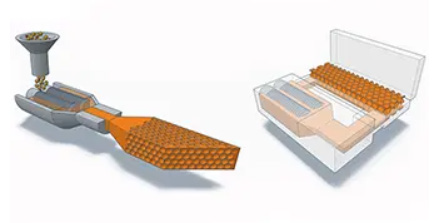
(Left) Extrusion foaming and (right) foam injection molding process of thermoset PU foam recycling
As a next step, the Northwestern team will partner with BASF to optimize and scale the polyurethane foam recycling process for large-scale applications.
Gallery