Istanbul Arel University has carried out an innovative study that will increase Türkiye's visibility on the international scientific stage in the field of space medicine. Presented as an oral presentation at the 76th International Astronautical Congress (IAC 2025), held in Sydney from 29 September to 3 October 2025, the project titled "Innovative Medical Care Solutions With Orally Dissolvable Nanostrips For Space Missions" attracted significant attention and introduced a groundbreaking approach to astronauts' health management and drug treatment.
Istanbul Arel University has authored an innovative study that will increase Turkey's visibility on the international scientific stage in space medicine. Presented as an oral presentation at the 76th International Astronautical Congress (IAC 2025) held in Sydney between 29 September – 3 October 2025, the project titled "Innovative Medical Care Solutions With Orally Dissolvable Nanostrips For Space Missions" attracted considerable interest and offered a groundbreaking approach to astronaut health management and pharmaceutical treatment.
Project Inception and Development Process
Work on the project began in the final quarter of 2023 and is being conducted with contributions from Erdi BULUŞ, Instructor at Istanbul Arel University Vocational School Department of Transport Services and Research Expert at ArelPOTKAM. The project team was formed through collaboration with Gülseren Sakarya (Bahçeşehir University), Ahmet Ümit Şahin (Gazi University / TENMAK) and Okan Sar (Ankara University / Hacettepe University).
The fundamental problem that inspired the project stems from the biological and physical challenges astronauts face regarding medication use in space missions. In microgravity environments, the dissolution rate, bioavailability and body distribution of medications change, causing disruptions in treatment timelines. Additionally, gastric disturbances, difficulty swallowing medications and dosing errors are among the health problems frequently encountered during space missions.
Developed to eliminate these challenges, "Orally Dissolvable Nanostrips" technology enables medications to enter the bloodstream directly through oral mucosa, providing both rapid and controlled medication intake mechanisms.
Scientific Foundation and Production Process of the Technology
The nanostrip system consists of drug-loaded nanoparticles integrated into biodegradable polymer matrices. This structure has been optimized to possess both biocompatibility and controlled-release properties.
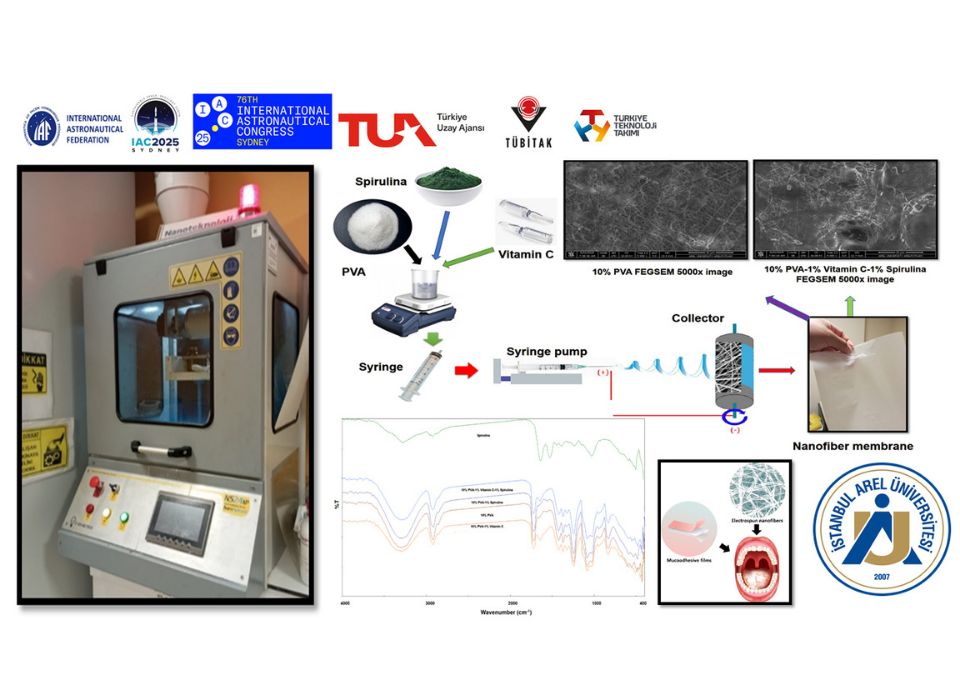
The production process was carried out within ArelPOTKAM, the YÖK-approved research and development centre of Istanbul Arel University. Here, nanofiber-structured membranes were successfully produced using the electrospinning method. This method made it possible to obtain nanostrips with high surface area, homogeneous structure and high drug-loading capacity.
Testing and characterization of the produced membranes were conducted in laboratories at Gazi University, TENMAK, Ankara University and Hacettepe University. In this scope, parameters such as biocompatibility, drug release profile, mechanical strength and surface morphology were examined in detail.
Additionally, micro-sensors integrated into the system enable real-time monitoring of astronauts' health data, medication intake frequency and biological responses. This sensor-based feedback mechanism allows for personalized medication dosing during space missions.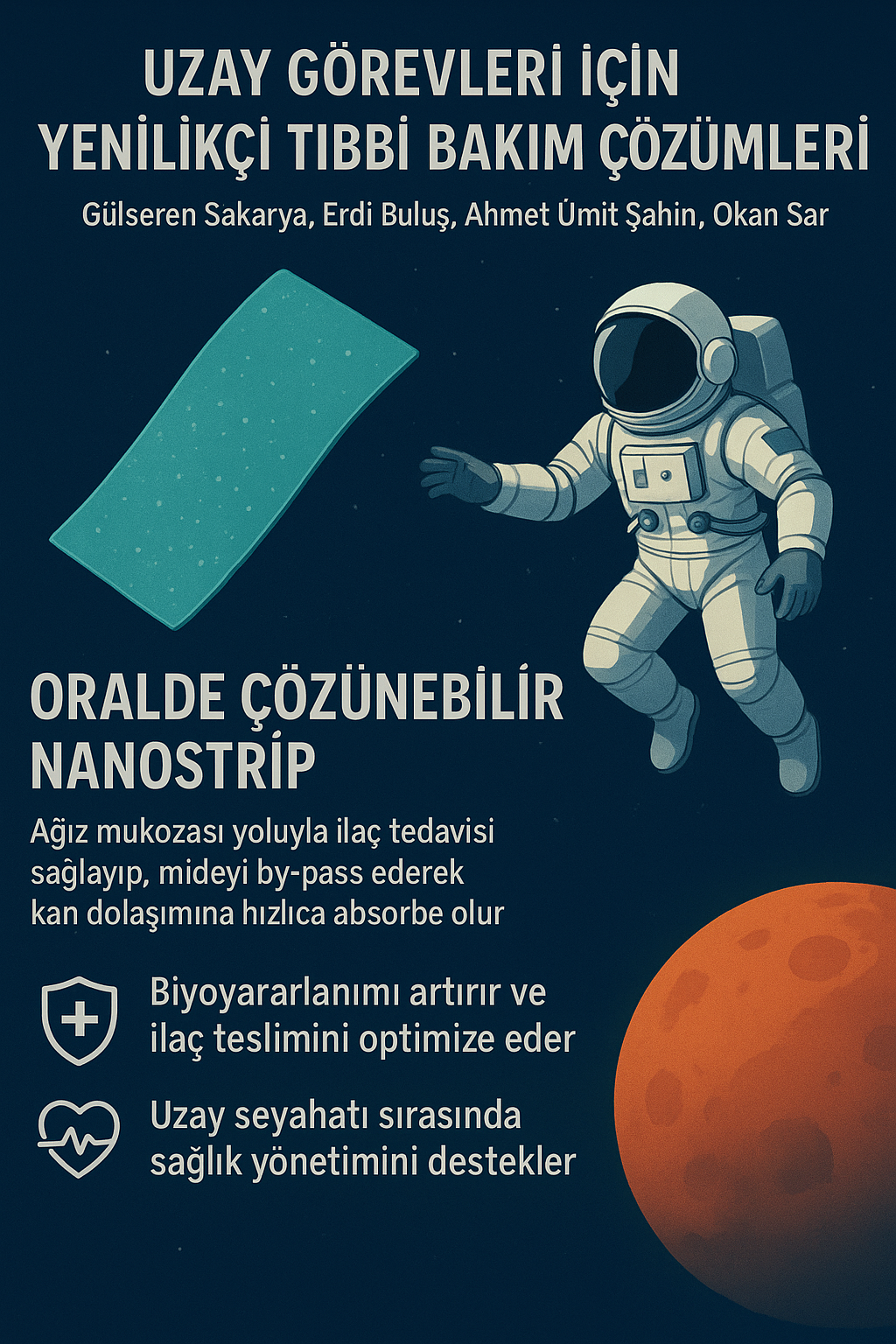
Project Objectives and Scientific Contribution
This project not only produces solutions for medication treatment problems in space missions, but also carries significant innovation potential under Earth conditions. It is particularly considered as a viable alternative for elderly and paediatric patients who experience difficulty swallowing medications.
Erdi Buluş shared the following statement regarding the topic:
"Our aim was to develop a practical treatment system that optimizes the efficacy and absorption rate of medications in microgravity environments while remaining usable on Earth. Orally dissolvable nanostrips will be a revolutionary step in both space and terrestrial medicine due to their ease of transport, controlled-release properties and biocompatibility."
Future Stages and Objectives
The research team is currently working on biocompatibility tests, pharmacokinetic analyses and performance evaluations under simulated microgravity conditions.
Additionally, experimental work is planned to assess the long-term stability of the system in space environments and its compatibility with different pharmaceutical active ingredients.
The project team continues its collaboration with the Turkish Space Agency (TUA), with the goal of establishing joint R&D and testing programmes for the future use of this technology in space missions.
Furthermore, the patent application process for the study will be initiated. The patenting process holds strategic importance both for protecting the intellectual property of the technology and for registering Turkey's innovative potential in space medicine at the international level.
Turkey's Rising Force in Space Medicine
This project holds great significance in demonstrating the scientific maturity Turkey has reached in nanotechnology, biomedical engineering and space medicine. Istanbul Arel University's interdisciplinary research vision has been realised once again on the international platform with this work.
This project, which develops innovative approaches in life support systems in space and pharmaceutical technologies, has been regarded as an important achievement representing Turkey's scientific production capacity in space research.
Project Team
• Erdi BULUŞ – Istanbul Arel University
• Gülseren SAKARYA – Bahçeşehir University
• Ahmet Ümit ŞAHİN – Gazi University / TENMAK
• Okan SAR – Ankara University / Hacettepe University
Gallery