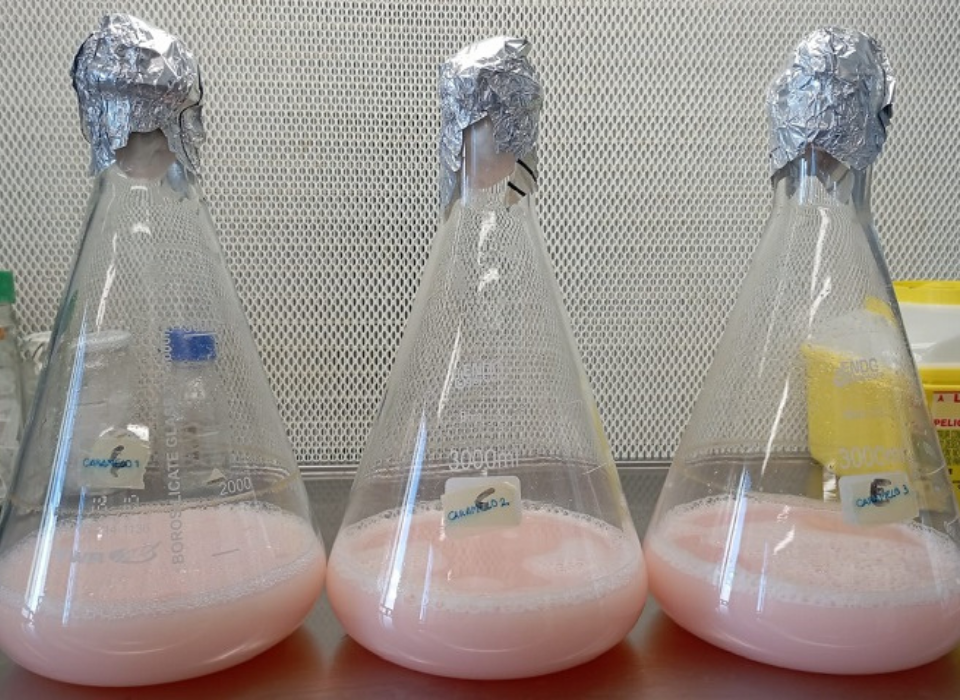
The Applied Biochemistry research group at the University of Alicante, in collaboration with researchers from the Alicante Dr. Balmis University Hospital (HGUDB) and the Alicante Institute for Health and Biomedical Research (ISABIAL), has identified the cancer-preventive capacity of a pigment found in the Santa Pola salt flats. The pigment is produced by certain microorganisms—"halophilic archaea"—to protect themselves from the sun, and its antitumor capacity has been tested against several types of breast cancer.
The Applied Biochemistry research group at the University of Alicante, in collaboration with researchers from the Dr. Balmis University Hospital in Alicante (HGUDB) and the Alicante Institute of Health and Biomedical Research (ISABIAL), has identified the cancer-preventive capacity of a pigment found in the Santa Pola salt marshes. This pigment is produced by certain microorganisms—"halophilic archaea"—to protect themselves from sunlight, and its antitumor capacity has been tested in several types of breast cancer.
Biology Professor and group director Rosa María Martínez explains that this significant finding, published in the prestigious Nature Scientific Reports journal, began with the development of Micaela Giani's doctoral thesis. Giani had demonstrated there—through in vitro (laboratory environment) tests—the pigment's antioxidant activity and its effect on enzymes (biocatalysts) that play a role in pathologies such as diabetes or metabolic syndrome.
Following the announcement of these results to the public, researchers hypothesized that this pigment, which possesses almost 300 times higher antioxidant activity than other antioxidants, could limit the growth and proliferation capacity of cancer cells. They became curious to see what would happen when they added cancer cells to the pigment.
In this second phase, the research group worked in collaboration with Dr. Gloria Peiró, a pathologist at HGUDB and lecturer in the Biotechnology Department at the University of Alicante, and Yoel Genaro Montoyo-Pujol, a Doctor of Experimental and Biohealth Sciences and researcher also at the University of Alicante, both members of the breast cancer and immunology research group within ISABIAL. Thanks to this collaboration, the effect of the pigment in question could be tested in vitro in cell lines representing different intrinsic phenotypes of breast cancer and in a cell line representing healthy breast tissue.
According to Martínez, they concluded that the pigment caused no harmful effects on healthy cells at certain doses, but limited the growth capacity of neoplastic (tumoral) cells. Martínez also emphasized that this finding opens a door in biomedicine for the design of new cancer-fighting strategies based on the use of natural compounds that are harmless to the body.
Based on this discovery, as the researcher noted, before reaching clinical use in patients, there are several phases of development ahead: beginning with expanding the study to different cell lines of all other tumor types, continuing with tests on tissue samples from biopsies or surgical specimens to design possible therapeutic protocols using this pigment, and subsequently moving on to animal studies.
Gallery