In recent years, environmental impact and sustainability, alongside mechanical performance and lightness, have become an important evaluation criterion in the composites sector [1,2]. While traditional reinforcement materials such as glass and carbon fiber offer high strength, they also bring significant environmental burdens in terms of production processes, high carbon emissions and recycling stages [3]. The literature indicates that the carbon footprint of natural fiber-reinforced composites is lower than that of conventional systems [2,7]. This is increasingly boosting interest in natural fiber-reinforced composite systems within the sector.
Introduction
In recent years, the composites sector has recognized not only mechanical performance and light weight as important evaluation criteria, but also environmental impact and sustainability [1,2]. While traditional reinforcement materials such as glass and carbon fiber offer high strength, they entail significant environmental burdens in terms of production processes, high carbon emissions, and recycling stages [3]. Literature indicates that natural fiber-reinforced composites have a lower carbon footprint compared to conventional systems [2,7]. This has increased interest in natural fiber-reinforced composite systems in the sector with each passing day.
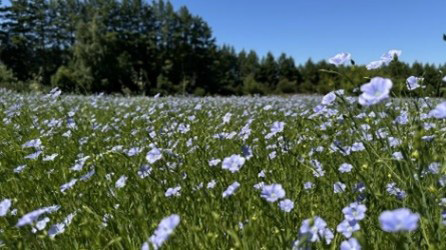
In this context, flax fiber, obtained from the flax plant, stands out as one of the natural reinforcement elements as an alternative to glass fiber thanks to its low density, renewable nature, and high specific mechanical properties [4,5]. The use potential of flax fiber-reinforced composites is foreseen in many areas, from automotive to the construction sector, from consumer products to light engineering applications [6].
Eskim Kimya's Sustainability and Research and Development Approach
Eskim Kimya R&D Center and Tezkom Composite qualified for the approved research and development center title with state support in 2024. The company continues its research and development efforts with a strong team comprising doctors, doctoral students, and master's graduates and students. In the research and development work carried out within Eskim Kimya, environmentally sensitive production understanding and sustainable material development approach are among the core objectives.
Accordingly, studies are being conducted on the use of renewable source raw materials, development of low energy consumption production processes, and creation of environmentally friendly product formulations. Flax fiber-reinforced composite systems form an important part of Eskim Kimya's vision for sustainable product development.
Composite Material Development with Natural Fiber Reinforcement via Bulk Molding Compound (BMC) Method
Within the scope of these studies, experimental research was conducted in the Eskim Kimya R&D center on the development of flax fiber-reinforced Bulk Molding Compound (BMC) systems. The advantages offered by the BMC process, including suitability for serial production, ease of molding, and high surface quality, present important opportunities for the integration of natural fiber-reinforced composites into industrial applications [8,9].
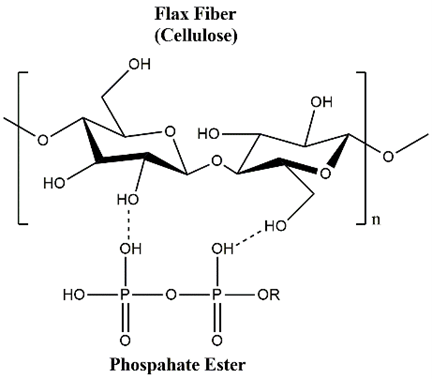
In this study, using the Bulk Molding Compound (BMC) method, composite materials containing natural fiber-based reinforcement elements in the same weight ratio as conventional glass fiber reinforcement were produced. Preliminary experiments were conducted using wetting additive agents with different surface active properties in order to determine the wetting behavior of flax fiber with unsaturated polyester resin.
As a result of preliminary studies conducted, additive agents containing active phosphoric acid ester in different ratios were found to be compatible with the system and these additives were preferred in experimental studies. In this context, the mechanical performance of BMC samples prepared using additive-free systems and wetting additive agents containing active phosphoric acid ester in different concentrations was comparatively examined. In accordance with the results obtained, the effects of wetting additive agents on fiber-matrix interface interaction and consequently on mechanical strength were evaluated.
Results
Within the scope of mechanical characterization of the produced composite samples, three-point bending testing was performed in accordance with ASTM D790 standard, tensile testing in accordance with ASTM D638 standard, and impact testing in accordance with ASTM D256 standard. Surface hardness properties of the samples were determined by Barcol hardness measurements in accordance with EN 59 standard.
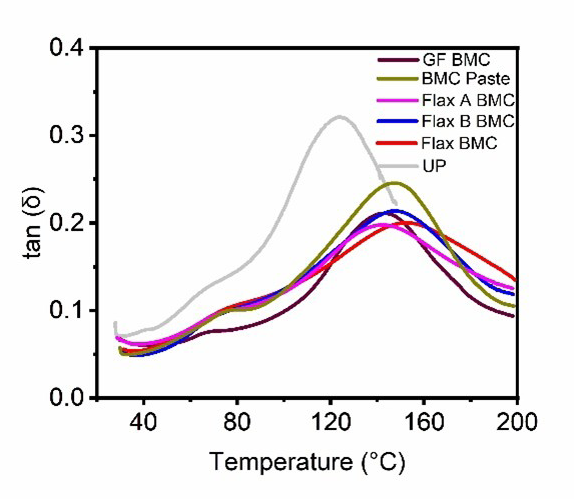
Within the scope of thermal characterization studies, heat deflection temperature (HDT) measurements were performed in accordance with EN 75 standard. Dynamic mechanical analysis (DMA) tests were applied to determine the viscoelastic behavior of the samples, and thermal stability and degradation behavior were investigated by thermogravimetric analysis (TGA) method.
The obtained mechanical and thermal test results were evaluated comparatively in terms of pure polyester (UP), fiber-free BMC formulation (BMC Paste), glass fiber-reinforced BMC (GF BMC), flax fiber BMC with wetting agent containing 50 percent active phosphoric (Flax-A BMC), and flax fiber BMC with wetting agent containing 100 percent active phosphoric (Flax-B BMC).
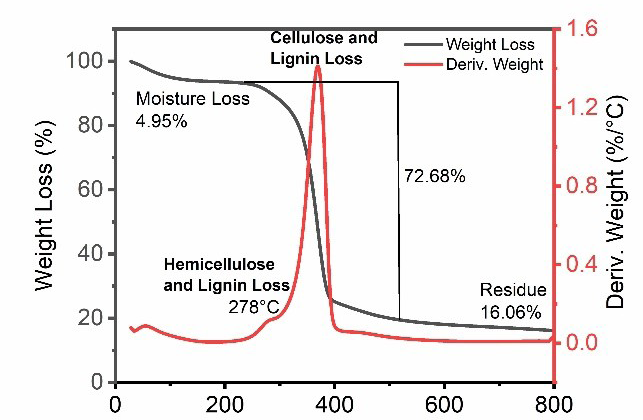
According to thermogravimetric analysis (TGA) results, it was determined that approximately 4.95 percent mass loss occurred up to 100 °C due to the hygroscopic nature and moisture retention property of flax fiber. This mass loss was evaluated to stem primarily from the removal of free and bound water adsorbed in the fiber structure.
When examining the thermal degradation process of flax fiber, it was found that the decomposition of hemicellulose and lignin components present in its structure began at approximately 278.37 °C. As temperature increased, the degradation of the cellulose and lignin phases, which form the main load-bearing structure, accelerated, and the maximum thermal degradation temperature was determined to be 369.08 °C.
As a result of experimental studies, while it was determined that flax fiber's limited degradation temperature presents certain restrictions in its use in flame retardant applications, it was observed that material density could be reduced by approximately 10 percent through its integration into composite structure.
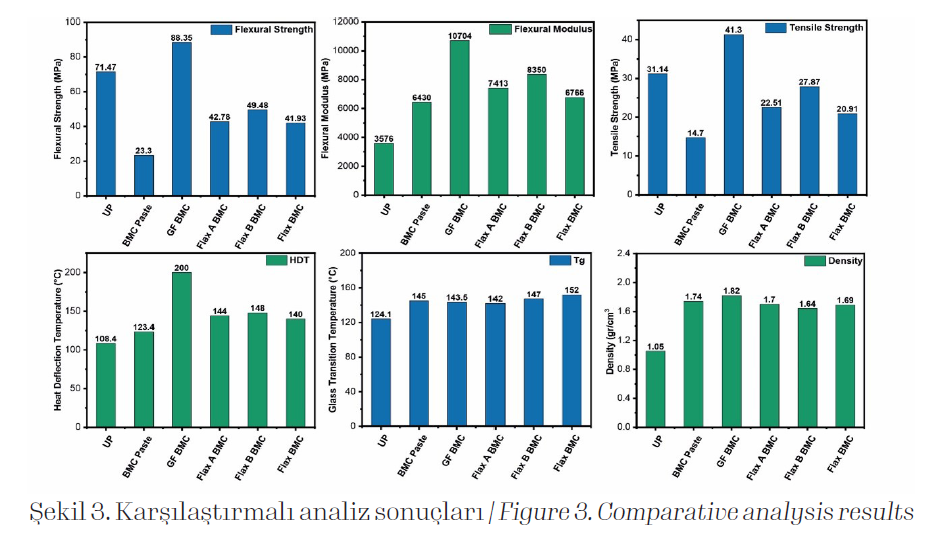
Furthermore, it was found that through the use of phosphoric acid ester-based wetting additive agents, fiber-matrix interface adhesion was improved, and consequently significant increases in tensile strength and elastic modulus values were achieved. Proper wetting of flax fiber and its homogeneous distribution played a determining role in the obtained mechanical performance; it was observed that by increasing the fiber ratio, strength levels close to glass fiber-reinforced systems could be attained, and composite density could be further reduced during this process.
When examining thermal characterization results, it was determined that flax fiber reinforcement did not raise heat deflection temperature (HDT) values to the level of glass fiber-reinforced systems, but did not create any adverse effect on the glass transition temperature (Tg) and did not compromise existing design requirements.
In this context, formulation development studies for flax fiber-reinforced BMC systems are ongoing, and in future research, adaptation of similar natural fiber-based formulations to the Sheet Molding Compound (SMC) process is targeted. In accordance with the findings obtained, the developed systems are evaluated to have significant potential particularly in lightweight-requiring automotive, electrical-electronic enclosure, and construction applications, and could contribute to lightweight design approaches.
References
[1] Faruk, O., Bledzki, A. K., Fink, H. P., & Sain, M. (2012). Biocomposites reinforced with natural fibers: 2000–2010. Composites Science and Technology, 72, 227–239.
[2] Pickering, K. L., Efendy, M. G. A., & Le, T. M. (2016). A review of recent developments in natural fibre composites. Composites Part A, 83, 98–112.
[3] Joshi, S. V. et al. (2004). Are natural fiber composites environmentally superior? Composites Part A, 35, 371–376.
[4] Yan, L., Chouw, N., & Jayaraman, K. (2014). Flax fibre and its composites – A review. Composites Part B, 56, 296–317.
[5] Baley, C. (2002). Analysis of the flax fibres tensile behaviour. Composites Part A, 33, 939–948.
[6] Bledzki, A. K., & Gassan, J. (1999). Composites reinforced with cellulose based fibres. Progress in Polymer Science, 24, 221–274.
[7] La Mantia, F. P., & Morreale, M. (2011). Green composites: A brief review. Composites Part A, 42, 579–588.
[8] Mallick, P. K. (2007). Fiber-Reinforced Composites: Materials, Manufacturing, and Design. CRC Press.
[9] Harper, C. A. (2006). Handbook of Plastics, Elastomers, and Composites. McGraw-Hill.
Gallery