Ejector Systems – Versatile, Reliable and Easy to Use
Ejectors, also known as jet pumps, provide motive force for conveying, compressing, heating or mixing gases, vapors, and solids in liquids or gases. They operate through conversion of pressure energy into velocity using appropriate nozzles. They can also be referred to as "pumps with no moving parts."
Figure 1. Ejectors with different designs and made from various materials
Operating Principle and Design
The fundamental principle of ejectors is that liquid or gas exiting the nozzle is entrained and accelerated at high velocity together with the surrounding liquid, gas or solid matter.As a result, the moving and entrained (suction) fluid mixture flows to a second nozzle with reduced velocity and increased pressure.Figure 2. Operating principle of the ejector
In the practical application of this principle, a simple arrangement with only 3 main components is required (Figure 2): • Driving nozzle (1) • Diffuser (2) • Body (3)And at least three connection elements are used:
• Motive medium inlet connection (A) • Vacuum manifold (B) • Discharge manifold (C) The pressure at connection points and corresponding mass flow rate determine the functional effectiveness of the jet pump.Jet pumps;
Can be manufactured with union nominal diameters from a few millimeters to 30 m, vacuum volumes from 1 to 2,000,000 m³/h and vacuum pressures up to 10-2 mbar to meet different requirements.Other characteristics:
• Simple design. • Reliable operation. • Long equipment life. • No moving parts design. • Low wear and erosion, minimal maintenance requirements. • Suitable for vacuum up to 0.01 mbar (absolute). • Use of product vapor as motive fluid. • Process-appropriate material alternatives (e.g. stainless steel, cast iron, Hastelloy alloy, titanium, graphite, PVC, PTFE, PP).Applications
Ejectors are versatile equipment that can be used in, for example, chemical processing plants, laboratories, mixing tanks, storage tanks, fermentation tanks, drinking water treatment plants, wastewater treatment plants, heating and cooling systems, power plants, gas pressure systems, heat recovery systems and vacuum pumps for vacuum generation. According to application areas, liquid, vapor or gas jet pumps, compressors, heaters and mixers are categorized.Below are a few examples of ejectors and their applications:
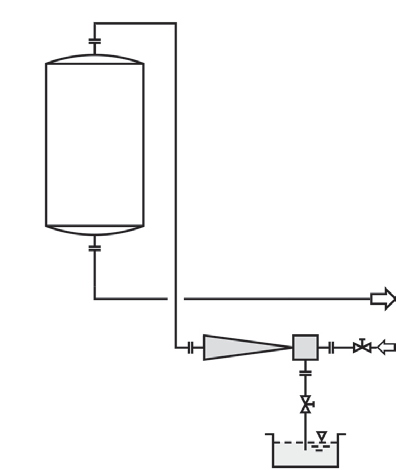
Liquid jet pumps; are used in water and wastewater treatment plants to convey and mix liquids such as water, acidic or alkaline solutions. One important application area is diluting acidic or alkaline solutions to a specific concentration in these plants. Liquid jet pumps are generally manufactured from stainless steel, PVC and PP. For use with corrosive materials, they can also be produced entirely from PTFE.Figure 3. Liquid jet pump used for conveying and mixing solutions
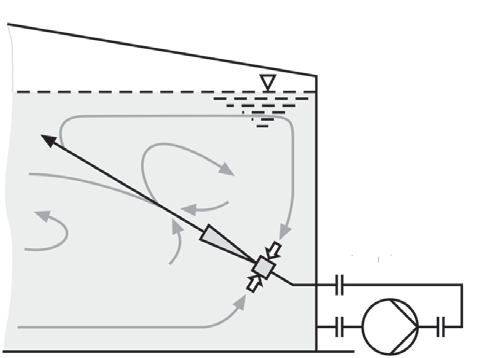
Liquid jet mixers are used for mixing and circulating liquids. With jet mixers, three-dimensional flow is achieved without rotational motion in the tank.
The application areas of liquid jet mixers are limited by the viscosity of the liquid to be mixed. As a rule, jet mixers can be used in situations where the liquid to be mixed can be supplied by a centrifugal pump. Liquid jet mixers are generally used in storage tanks and neutralization basins.Figure 4. Jet mixer in storage tank
Steam jet compressors, also called thermocompressors, are used to provide heat recovery in many thermal processing plants such as evaporation, distillation, crystallization, cooling, deodorization and gas purification operated under vacuum. Adjustable driving nozzles are used for applications under different operating conditions.Figure 5. Thermocompressor in seawater treatment plant
Steam jet heaters are used for heating liquids through direct injection of heating steam. Heating steam condensate mixes with the liquid to be heated. Steam jet heaters are used in many different areas for preparing hot water: In malting plants for barrel/drum washing, in tanneries for surface cleaning, in paints and oils for providing hot water, in toilets and bathrooms, in heating treatment sludge and in boiling solutions, etc. According to the application area, they are generally manufactured in two different designs - steam jet heaters for boilers and steam jet heaters for pipe installations for use in pass-through or circulation heating systems.Figure 6. Steam jet heater for heating liquid in boiler
Steam jet vacuum systems fundamentally consist of combinations of ejectors and condensers. They are suitable for vacuum down to 0.01 mbar (absolute) and are used in many industrial applications for creating and maintaining vacuum. For example: Chemical processing plants, vacuum distillation in oil refineries, deodorization in vegetable oil plants, seawater treatment plants, steel gas purification plants, fiber production plants, drying processes and odor and moisture removal plants.Figure 7. Multi-stage steam jet vacuum pump manufactured from graphite for use especially with abrasive gases and vapors
İlker Damar Sales Manager Industrial Applications GEA Turkey Peter Trefzer Chemistry Department Ejector Systems Manager GEA Wiegand GmbHAdvertisement
Ad Space728 × 90