Turkish Student Alper Tapkı Reaches the Arctic Through Rosatom's Icebreaker of Knowledge Project

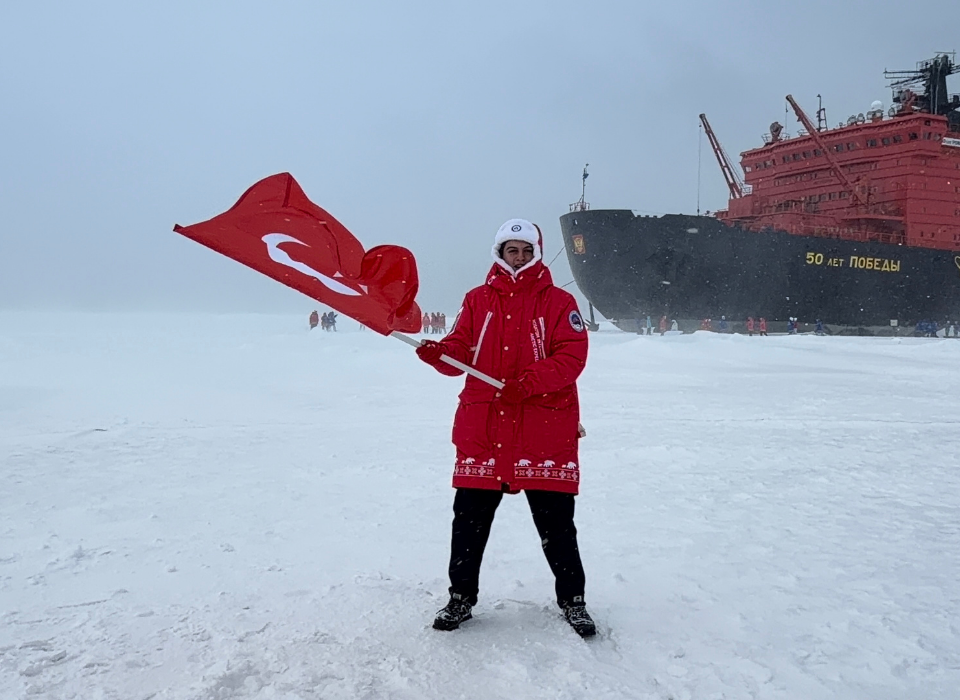
As part of the "Icebreaker of Knowledge" science and education project, organized by Rosatom for the 7th time this year, young people from different countries around the world reached the North Pole aboard the nuclear icebreaker "50 Let Pobedy." Alper Tapkı, a high school student from Turkey who took part in the international expedition, flew the Turkish flag at the North Pole.
Under the “Icebreaker of Knowledge” science and education project, held for the seventh time this year by Rosatom, young people from different countries reached the North Pole aboard the nuclear icebreaker “50 Let Pobedy”. High school student Alper Tapkı, who took part in the international expedition from Türkiye, flew the Turkish flag at the North Pole.
The seventh season of the “Icebreaker of Knowledge” science and education project, organised by the Russian state nuclear energy corporation Rosatom, has been completed. Bringing together high-achieving high school students from different countries, the project took the young people on a 10-day expedition aboard the nuclear icebreaker “50 Let Pobedy” along the Murmansk-North Pole-Franz Josef Land-Murmansk route.
Participants returned to the starting point, Murmansk, after the expedition. This year’s voyage was also notable as the 200th surface-vessel expedition to the North Pole.
Young people took part in scientific work in the Arctic
A comprehensive science and education programme was organised for the students throughout the expedition. As part of the programme, which included a genuine aerospace laboratory on board the nuclear icebreaker, participants carried out various experiments alongside scientists.
The students launched a radiosonde intended to provide communications in the Arctic’s hard-to-reach regions and along the Northern Sea Route, and also took part in tests of the world’s first recoverable stratospheric platform.
Yegor Plakhotnyuk, an expert on the Icebreaker of Knowledge project and Project Manager of the Genomic Technologies and Tissue Engineering Laboratory at the Research Institute of Technical Physics and Automation within Rosatom’s Science Division, drew attention to the importance of young people coming into direct contact with scientific and technological work.

Turkish student represented Türkiye at the North Pole
High school student Alper Tapkı, who took part in the project from Türkiye, described the North Pole experience as one of the most special of his life.
Tapkı said that travelling through the Arctic Ocean on a nuclear icebreaker, seeing the ice up close and standing on the ice at the North Pole had been an unforgettable experience for him.
Noting that he had spent 10 days on the same ship with peers from different countries, Tapkı said the common ground of science, technology and exploration had brought together young people from different cultures.
Saying it was a particular source of pride to represent Türkiye in an international science and education project, Tapkı said the journey had further increased his interest in science and technology.
International event held at the North Pole
On the day the expedition reached the North Pole, an international circle dance was performed around the 90° point. The Bashkir music group AY YOLA accompanied the event with a live performance.
During the voyage the students also wrote a science fiction story together with the science fiction author Sergey Lukyanenko. The story is due to be published on the social media accounts of Rosatom’s Icebreaker of Knowledge project.
Around 5,000 students from 22 countries competed
Around 5,000 students from 22 countries took part in the international selection process for a place on the Icebreaker of Knowledge project’s North Pole expedition.
Alongside Türkiye, students from Armenia, Bangladesh, Belarus, Bolivia, Brazil, Hungary, Vietnam, Egypt, India, Indonesia, Kazakhstan, China, Kyrgyzstan, Mongolia, Myanmar, Namibia, Rwanda, Serbia, Tanzania, Uzbekistan and South Africa took part in the selection.
The selection process, which began on 5 May, was carried out in three stages. In the first stage students’ knowledge of the natural sciences, advanced technologies, nuclear energy and Arctic exploration was assessed. In the second stage, online seminars were held by experts from the nuclear energy sector.
In the final stage finalists were asked to prepare creative work on the theme “How are nuclear technologies changing the world today?”. The entries were assessed by an international jury made up of experts from the nuclear sector, science, education, Arctic research and science communication.
More than 470 students have visited the Arctic through the project
Over the seven seasons of the Icebreaker of Knowledge project, more than 470 students from different countries have taken part in the Arctic expeditions organised by Rosatom.
The project gives students the opportunity to get to know an operational nuclear icebreaker at first hand and to see work in nuclear energy, science and advanced technology on the spot.
The growing importance of the Northern Sea Route
The Northern Sea Route (NSR) stands out as an important maritime transport corridor linking western Eurasia with the Asia-Pacific region.
Designated as the infrastructure operator of the Northern Sea Route by the Government of the Russian Federation in 2018, Rosatom coordinates work on developing the route.
Russia is currently the only country with a fleet of nuclear icebreakers. Operated by FSUE Atomflot within Rosatom, the fleet consists of eight nuclear icebreakers.
Gallery