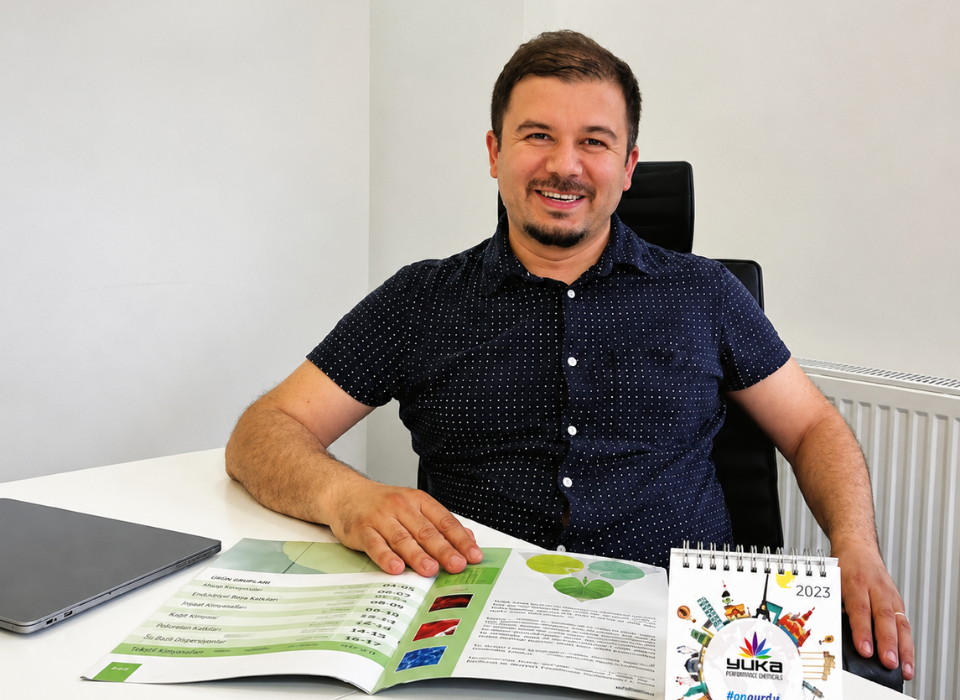
Yalçın Şentürk Named to Atılım Makina's Board of Directors
We conducted an enjoyable interview with Yalçın Şentürk, Board Member of Atılım Makina, discussing the company's 30-year success story, new projects and objectives.
Could you briefly tell our readers about yourself, your education and professional background in the sector?
Hello, to briefly introduce myself, after studying Electrical and Electronics Engineering at Koç University in 2001-2002, I transferred to Sabancı University. After studying Mechatronics Engineering for 1.5 years, I changed departments and graduated from Sabancı University's Department of Production Systems Engineering in 2007. For many years I established and operated my own company in the IT, information technology and security systems sector, where I undertook projects for many corporate firms. In 2013 I began working at my own company, Atılım Makina. In 2014 I obtained my Class C Occupational Health and Safety Specialist certificate and continued on our path.Could you describe the development process of Atılım Makina from its establishment to today?
Since 1986, our company has undertaken the manufacture of all types of processes, turnkey facilities, construction, standard and special-purpose machinery required by the chemical and paint industries. We are among the oldest companies in the sector; in the last 10 years we have been operating with 70% focus on exports. We serve in many countries around the world, primarily the Middle East and Africa. We had a long-term partnership with the Spanish firm Oliver&Battle, a global leader in the sector. We understand that experience and training together produce excellent results; for this reason our company achieves excellent outcomes with its specialized and experienced technical staff and master craftspeople who have been with us for over 10, 20, even 30 years since our establishment. Despite navigating through many difficulties during this challenging process that began many years ago, both nationwide and within our company, we are now carrying out projects in many countries around the world through our work focused on design-oriented technology.What are Atılım Makina's products and product groups? Which sectors does it serve?
As Atılım Makina, we add new members to the chemical and paint sector by establishing turnkey production facilities. In this process, from machinery production through facility setup, first product manufacturing and staff training, we assume all responsibility. Plasticizer facilities, polyester facilities, PVA facilities, stern acrylic facilities, alkyd resin facilities, formaldehyde facilities, biodiesel facilities, thinner facilities, varnish facilities, water and solvent-based paint facilities, ink facilities, hot melt facilities. We provide machinery production and mechanical solution partnerships to major companies in the chemical and paint sector primarily in Turkey and in many countries around the world. Reactors, mixers, basket mills, stock tanks, heat exchangers, decanters, bunkers, filters, columns, washing systems, pilot facilities.Have you recently produced any differentiated, innovative machinery for the sector?
As Atılım Makina, during our long years in the sector we have produced many innovative processes and machinery that have contributed to the sector. I would like to discuss 3 of the most important ones. A resin scraping or barrel shredding machine."We provide machinery production and mechanical solution partnerships to major companies in the chemical and paint sector primarily in Turkey and in many countries around the world."
First, I would like to discuss our recent R&D work. Certain types of resins are heated to a specific temperature and, in liquid form, are molded from thin sheet and filled into easily tearable barrels. Subsequently they solidify inside the barrel and are transported in this state. Companies using resin as a raw material manually shred and remove the resin from inside. However, this operation is very tedious and time-consuming, and while the barrel is being shredded, some resin is lost and turns to dust. Machines for this operation exist abroad but are very expensive. Here we manufactured our first machine performing the same operation at approximately 8 times lower cost and it is currently in use by our customer. Second, I would like to discuss work on a kettle washing machine that we developed years ago but which brought me satisfaction as someone who loves nature, which I believe is very important for both the environment and worker health.Although the kettle washing machine was requested and designed to reduce labor, time and cost losses, it holds a very important place for worker health and environmental pollution prevention.
In the chemical and paint sector, the best way to reduce environmental pollution is to generate as little waste as possible and ensure their recycling. Kettle washing machines are a system that performs both of these functions in their field. Many companies in the paint, food, adhesive and similar sectors use mobile kettles in different sizes and capacities. Like many equipment in this sector, equipment must be cleaned during product changes. Solvent-based solvents are used to dissolve and clean certain chemicals. Cleaning of mobile kettles is generally done manually by workers. Here the solvent is used once and the worker must continually inhale and come into contact with the solvent. The kettle washing machine we developed using TÜBİTAK R&D support washes kettles of different diameters and lengths in a closed environment in short periods, minimizing solvent consumption and loss, while simultaneously separating and recycling used solvent for repeated use. Finally, I would like to discuss a chemical process we developed that has led to our name being mentioned frequently in the sector; the DOTP (Dioctyl Terephthalate) production process. DOTP is a non-phthalate plasticizer that is the diester of terephthalic acid and branched-chain 2-ethylhexanol. In recent years, DOP chemical substance has been banned in Europe due to its carcinogenic effects and is expected to be banned in other countries as well. DOTP is a plasticizer type that has recently been increasingly produced as an alternative to this product. As a result of the experience and trials we have gained over many years, we have achieved 75% reduction in energy and labor costs compared to classical production methods; we have also succeeded in reducing the same 18-hour production period to 8 hours.What are your projects within the scope of new technological trends?
Most recently, within the scope of KOSGEB SME GEL support program on domestic technology cooperation and digitalized business processes, we have begun work on welding robot installation. In this process we plan to perform our welding operations in a more quality and faster manner. Additionally, we have realized a portion of the software and hardware investments we are considering adding to our company, such as 3D Printer, drone, 3D design and design programs, 3D animation programs, analysis and simulation programs; we plan to reach our technological investment targets that we will be able to use shortly with state incentives and support.What does Industry 4.0 mean for you? What are your projects and work related to this?
In almost all of the facilities we have established, we use automation PLC and Scada systems; we are in constant contact with our partner companies on this matter. I look at this issue in two ways; first, being able to produce solutions to problems such as the high costs we currently experience in these automation systems, monitoring, and so forth. Many of the facilities we have established are abroad and the remaining facilities are in different cities throughout Turkey. Problems experienced in these facilities require difficult and complex service and intervention situations; we have many expectations that can offer us solutions regarding the high costs created by licensing and hardware prices during installation. Second, I would like to discuss unmanned, remotely accessible chemical facilities that we will establish in the future. As is known, chemical facilities are among the highest-risk sectors in terms of occupational safety, worker health and environmental pollution. I believe the best way to reduce risks is to minimize human factors. Workers being able to control the facility from outside the production area and the elimination of risks such as inhalation and contact with chemical substances, and not being present in the area in case of any danger could be the most effective method for these issues. Additionally, it could help eliminate accidents caused by fatigue, lack of attention, inadequate training and similar reasons through artificial intelligence. "We are the only company in the sector with a facility at a university; we have our pilot facility and laboratory where we conduct R&D activities at our campus at Gebze Technical University."What strategies do you apply to identify customer expectations?
To answer this question, I need to divide our customers under two headings. Those in the sector who are investing for a need, renewal or capacity increase, new secondary product manufacturing. Those outside the sector who want to invest and enter the sector for the first time. For the first of these two groups, those within the sector; we first analyze whether their requests truly meet their needs. If their requests are incorrect or insufficient, or if we have a better solution, we direct them accordingly. Our job is to produce mechanical and physical solutions. For this reason we first want to understand our customers' problems. Second, for our customers outside the sector, we first try to understand how sound the feasibility of the investment they will make is, and we communicate our recommendations based on our experience on this matter. For us, true success is not so much new business agreements but seeing the projects we have established come to life and transform into profitable investments over many years.Given that our life resources are under threat today, the necessity of environmental measures has increased even further. What work have you done for a sustainable future?
In my opinion, one of the most important things we do for the chemical and paint sector in this regard is minimizing energy consumption and waste in the facilities we establish. In newly established facilities we are making contributions by continuously conducting R&D work on this matter. Additionally, we are making efforts as a company in our field both by directing our customers in this sector and by maintaining the red lines in our projects.What work do you have regarding R&D activities?
We are continuing our work to establish an R&D center within our company. On the other hand, we are the only company in the sector with a facility at a university; We have our pilot facility and laboratory where we conduct R&D activities at our campus at Gebze Technical University. We are also able to use the university's own laboratories there. We have R&D work that we have been conducting for many years with support from professors at the university on chemical processes. The DOTP production process I mentioned earlier is one of the fruits of these efforts.Advertisement
Ad Space728 × 90