Aarhus University Researchers Discover New Method for Polyurethane Recycling

The vast majority of polyurethane products worldwide that reach the end of their service life are incinerated or sent to landfills. However, this poses a problem, as the basic components of the material are predominantly derived from fossil oil. Moreover, the quantities involved are quite high. While the global PUR market reached approximately 26 million tons in 2022, forecasts for 2030 predict this amount will rise to approximately 31.3 million tons. Foams in various forms make up approximately 60% of this.
Nevertheless, there is a small but growing sector that chemically breaks down PUR (depolymerization) into its basic components, polyol and isocyanate, with the aim of reusing these as raw materials in new PUR products.
However, there is still a long way to go before the resulting products can truly compete with "primary" (virgin) materials. Separating and purifying the desired components is a costly process.
Breaking down and separating in a single step
This is where a research team from Aarhus University comes in with a clever idea. The researchers base their method on a method already used by such companies, namely the breakdown of PUR foam with acid (acidolysis).
However, companies do not separate the decomposed PUR into polyol and isocyanate. As a result, a mixture emerges that cannot be directly recycled and requires customers to use new formulations.
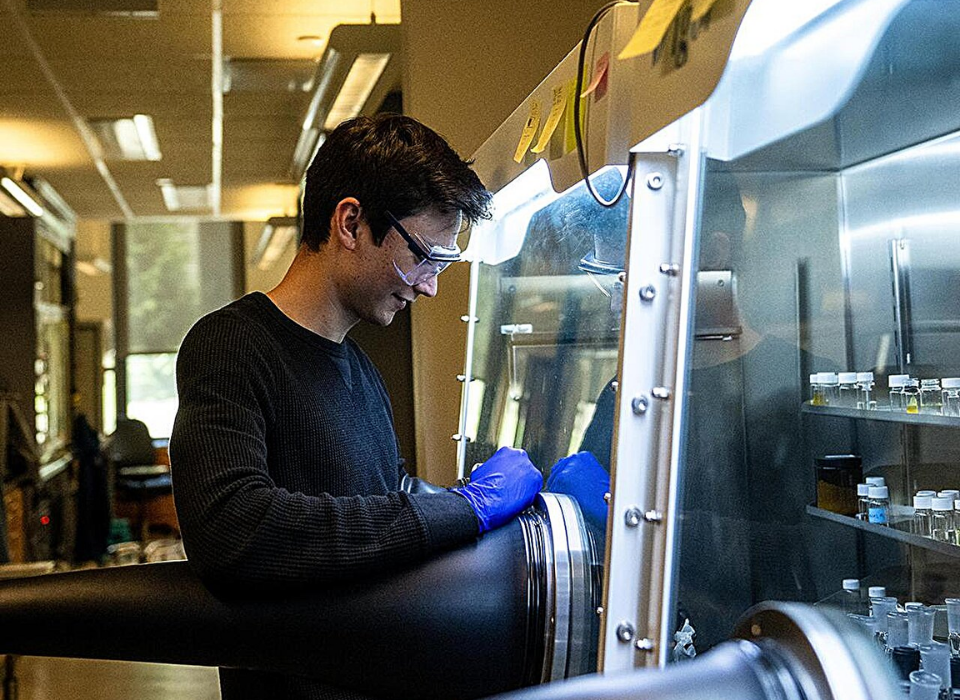
Aarhus University researchers do not merely break down PUR and separate the two basic components; they can accomplish this in a single step. They heat flexible PUR foam up to 220°C in a reactor containing a certain amount of succinic acid (see info box). They then use a filter that retains one material while allowing the other to pass through.
The component that passes through the filter becomes polyols, and these are obtained at a quality comparable to primary polyol. This makes it possible to use them in the production of new polyurethane. The solid part of the product mixture retained in the filter is converted into so-called diamine through a simple hydrolysis process. Diamine is used in the production of isocyanates and thus PUR.
Through this method, the researchers can recover up to 82% by weight of the starting material in flexible PUR foam used in mattresses, in the form of two separate fractions consisting of diamine and polyol. The researchers recently published their findings in the scientific journal Green Chemistry.
Significant potential for the industry
Steffan Kvist Kristensen, one of the study's authors and an associate professor at Aarhus University's Interdisciplinary Nanoscience Center (iNANO), commented that "the method is easy to scale up to industrial dimensions." Kristensen sees great potential for recycling PUR foam waste at factories that use it as raw material (slabstock) in their production. However, he adds, "Further development is needed so that PUR waste originating from consumers can also be processed."
Each manufacturer in the PUR sector uses its own unique formulations to achieve specific material properties in their products. Therefore, in order to create a truly economical cycle in polyurethane recycling, various problems such as waste separation, logistics, and the classification of PUR according to different types need to be solved: Thus, depolymerization constitutes only a small part of the solution.
Aarhus University researchers also tested the combination of acidolysis and hydrolysis on regenerated PUR foam and rigid PUR foam. This method works, but the path to a circular economy is even longer here.
Rigid PUR foam is mainly used in insulation materials, but efforts to convert it into valuable raw materials are still at an early stage.
The researchers are currently testing the new technology on other polyurethane materials to investigate how they can be recycled. They are also examining how the dicarboxylic acid, which is part of the process, can be reused. In addition, they will conduct tests to demonstrate that the technology can truly create a circular economy by producing new products from recycled materials.
Advertisement
Ad Space728 × 90