High Performance Thermoplastics: Polymers in Advanced Engineering Applications
1. Introduction
The performance expected from engineering materials exceeds the limits of conventional thermoplastics. Especially in the automotive, aerospace, electronics and energy sectors, the need for materials that can operate at higher temperatures, resist chemicals, have low weight and long service life is increasingly growing.
This need has accelerated the development of high performance thermoplastics. Polymers such as PEEK (Polyether Ether Ketone), PEKK (Polyether Ketone Ketone), PPS (Polyphenylene Sulfide) and PEI (Polyetherimide) are able to combine properties such as high temperature resistance, mechanical performance and chemical resistance within the same system.
In these materials, performance is determined not only by the chemical structure of the polymer, but also by crystallinity, molecular weight, additives and processing conditions. For this reason, material design and process design cannot be considered separately in high performance thermoplastics.
2. Relationship Between Molecular Structure and Performance
The superior properties of high performance thermoplastics are rooted in their molecular structure. The incorporation of aromatic rings into the polymer backbone increases chain rigidity and thermal stability, while functional groups (ether, ketone,…) determine chain mobility and intermolecular interactions. For example, the aromatic rings and ketone groups in the PEEK (Polyether Ether Ketone) structure provide high thermal and mechanical strength, while the ether groups impart a certain flexibility to the chain.
In semi-crystalline polymers, the degree of crystallinity is also a determining factor for performance. Crystallinity affects hardness, chemical resistance, dimensional stability and mechanical properties under temperature. The fact that PEKK (Polyether Ketone Ketone) crystallizes more slowly compared to PEEK (Polyether Ether Ketone) can allow the degree of crystallinity to be adjusted in a more controlled manner during processing.
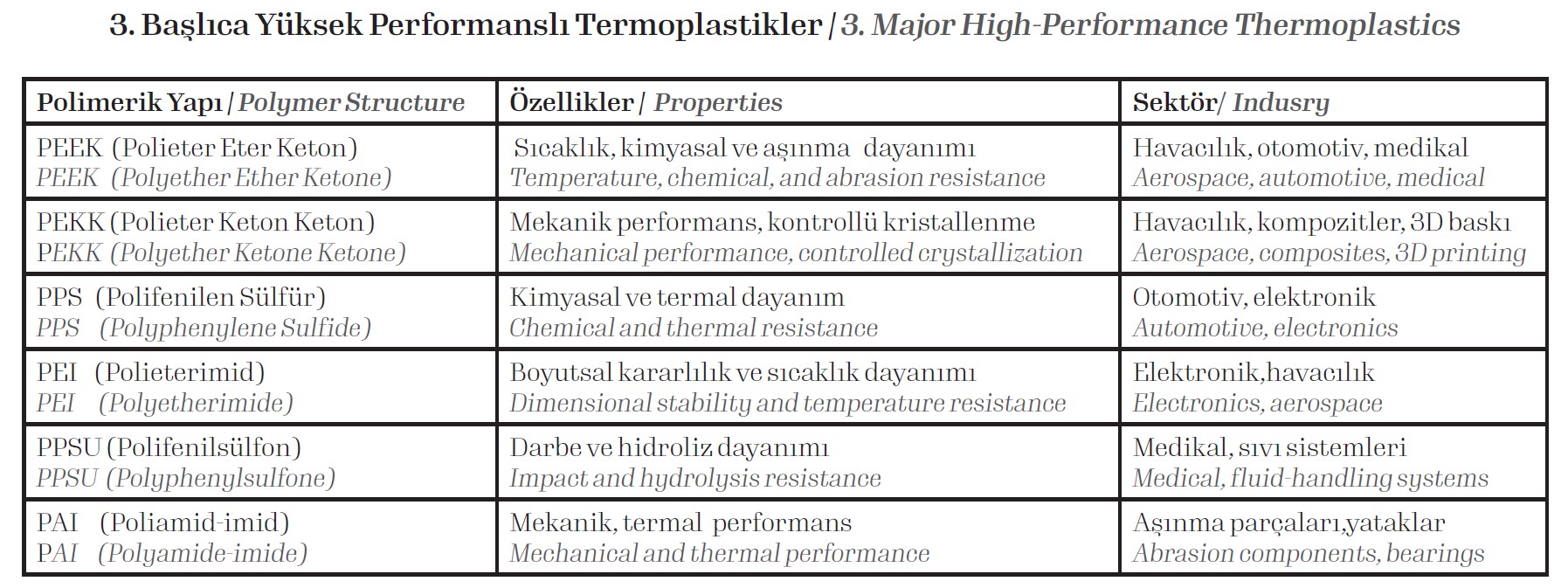
PEEK (Polyether Ether Ketone) is one of the most widely studied polymers among high performance thermoplastics. Thanks to its high temperature and chemical resistance as well as its wear properties, it can be used in gears, bearings, sealing elements and various moving components.
PEKK (Polyether Ketone Ketone) is one of the important members of the PAEK (Polyaryl Ether Ketone) family. Due to its controlled crystallization behavior, high mechanical performance and process flexibility, it draws particular attention in advanced composites and additive manufacturing applications.
PPS (Polyphenylene Sulfide), on the other hand, stands out especially in automotive and electronics applications where chemical resistance and dimensional stability are important. Amorphous thermoplastics such as PEI (Polyetherimide) and PPSU (Polyphenylsulfone) are evaluated in applications where, in addition to high temperature performance, impact resistance, dimensional stability or hydrolysis resistance are important.
4. Processing Technologies and Process Control
The superior properties of high performance thermoplastics also require more controlled process conditions during processing.
In high temperature thermoplastics such as PEEK (Polyether Ether Ketone) and PEKK (Polyether Ketone Ketone), melt viscosity and high processing temperatures require injection molding, extrusion and additive manufacturing processes to be designed carefully.
Particularly in semi-crystalline polymers, the cooling rate can change the degree of crystallinity and thus the final mechanical properties. For this reason, mold temperature, melt temperature, cooling conditions and process duration are not only production parameters but also parameters that determine material properties.
In recent years, the use of high performance thermoplastics in 3D printing and additive manufacturing applications has also been rapidly developing. Materials such as PEEK (Polyether Ether Ketone) and PEKK (Polyether Ketone Ketone) enable the production of complex geometries that are difficult to create with conventional manufacturing methods.
5. Composite Systems
The properties of high performance thermoplastics can be taken to more advanced levels using carbon fiber, glass fiber, graphite, PTFE (Polytetrafluoroethylene) and various mineral or nano fillers.
In particular, carbon fiber reinforced PEEK and PEKK systems are gaining importance in aerospace and advanced engineering applications due to their high stiffness-to-weight ratios.
Filler selection should not be made solely for the purpose of increasing mechanical strength. In tribological applications, friction and wear behavior can be targeted, electrical conductivity in electrical applications, and thermal conductivity in thermal applications. This approach transforms high performance thermoplastics from being a standard plastic into a material platform that can be specifically designed for the application.
6. High Performance Thermoplastics and Thermoset Polyurethanes
High performance thermoplastics and thermoset polyurethanes are important polymer technologies that meet different performance needs.
Since chains in thermoplastics do not form permanent three-dimensional cross-links, the material can be re-softened and reshaped under appropriate temperature conditions. In contrast, in thermoset polyurethanes, a three-dimensional cross-linked structure is formed as a result of curing, and the material cannot be remelted in the classical sense.
One of the important advantages of polyurethanes is that they can be chemically designed. Hardness, elasticity, wear resistance, impact damping and chemical resistance can be controlled by changing the choice of polyester or polyether polyol, diisocyanate type, chain extender and cross-link density.
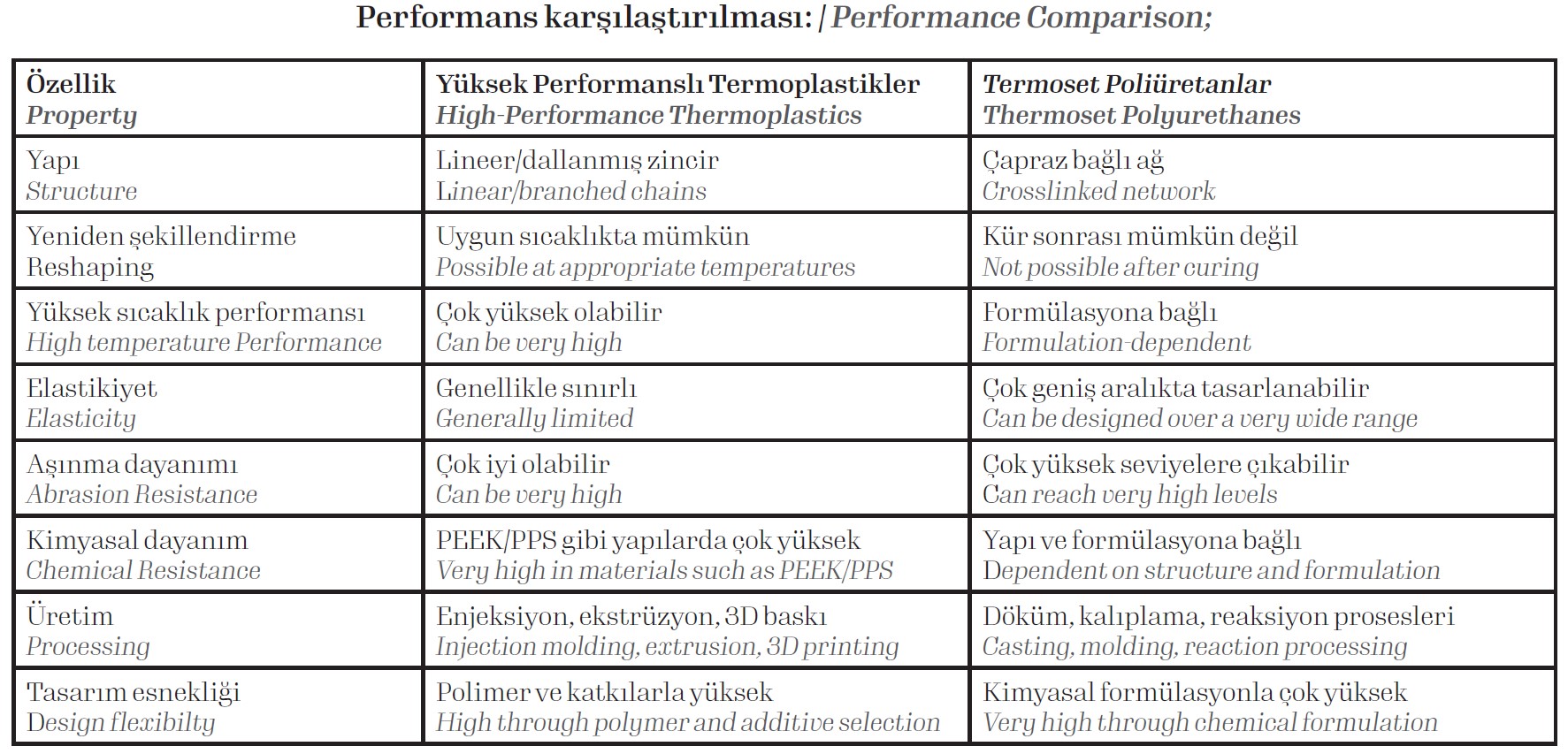
The important point here is that high temperature resistance and elastomeric performance are not the same concept. While thermoplastics such as PEEK or PPS can maintain their rigidity and dimensional stability at high temperatures, polyurethanes can provide significant advantages in terms of elasticity, vibration damping and wear resistance.
For example, while PEEK or PPS may be a suitable choice for a gear operating at high temperature or a component used in a chemically aggressive environment; specially formulated polyurethanes can provide advantages in rollers, wheels, elastic couplings or impact damping elements.
7. Future Polymer Technologies
The spread of electric vehicles, the need for weight reduction in aviation, electronic systems operating at high temperatures and advanced medical applications are increasing interest in high performance thermoplastics.
In particular, carbon fiber reinforced thermoplastics, high performance 3D printing materials, new generation PAEK systems and recyclable thermoplastic composites are among the important research areas of the future.
However, in the polymer technology of the future, no single material is expected to replace all other materials. It is the development of hybrid and application-specific systems in which molecular structure, additive system, process and application are designed together.
8. Conclusion
High performance thermoplastics represent one of the advanced material classes reached by polymer technology. Polymers such as PEEK, PEKK, PPS, PEI, PPSU and PAI can together offer high temperature resistance, chemical resistance, mechanical performance and long service life.
However, actual performance is not determined solely by the polymer itself. Molecular structure, crystallinity, additive system, process conditions and usage conditions must be evaluated together.
Thermoset polyurethanes, on the other hand, offer a different approach and can be formulated across a wide range of hardness, elasticity and wear resistance. For this reason, high performance thermoplastics and polyurethanes can be regarded as technologies that meet different engineering needs rather than being alternatives to each other.
In conclusion, high performance thermoplastics are not simply alternative materials that can be used in place of metals. They are; new generation polymer technologies that enable the development of lighter, more durable, longer-lasting and application-specific engineering solutions.
Gallery
Advertisement
Ad Space728 × 90