Investigation of Water Solubility Behavior of Polyvinyl Alcohol Films with Different Degrees of Hydrolysis and Viscosity

Abstract
Polyvinyl alcohol (PVA) is a synthetic and hydrophilic polymer widely used in water-soluble film applications thanks to its dissolution behavior, which varies depending on its degree of hydrolysis and molecular weight. In this study, the effect of four commercial PVA grades (Sample 1, Sample 2, Sample 3 and Sample 4) with different degrees of hydrolysis and viscosities on film solubility was investigated experimentally. PVA solutions were prepared by first dispersing PVA in water at 25 °C and then raising the ambient temperature to 80 °C; using the solvent-casting method, films were cast at a wet film thickness of 300 µm onto ceramic plates measuring 20 × 30 cm using a film applicator, and dried at 40 °C for approximately 3 hours. The average dry film thickness of the films obtained after drying was determined to be approximately 75 µm. Samples were fixed to a stainless steel holder with a 40×40 mm inner frame and dissolved in 1000 mL of pure water using the vortex mixing method; disintegration and complete dissolution times were recorded with a stopwatch.
The results showed that complete dissolution time ranked as Sample 1 (45 s) < Sample 2 (75 s) << Sample 3 (3600 s) < Sample 4 (4500 s). The fastest-dissolving, partially hydrolyzed grade was Sample 1, while the slowest-dissolving was Sample 4, the fully hydrolyzed grade with the highest viscosity. The findings revealed that even among grades with similar viscosity, an increase in the degree of hydrolysis extended the dissolution time by approximately 48-fold, demonstrating that PVA film solubility is primarily determined by the degree of hydrolysis, while viscosity has a secondary but measurable effect. The study provides comparative data on the dissolution performance of different PVA grades, contributing to the selection of the appropriate PVA grade for applications such as unit-dose detergent systems, water-soluble packaging, and similar uses.
Keywords: Polyvinyl alcohol, PVA film, degree of hydrolysis, viscosity, dissolution time
1. Introduction
Polyvinyl alcohol (PVA) is a linear-chain, synthetic and water-soluble polymer obtained through the alcoholysis (hydrolysis or saponification) reaction of polyvinyl acetate. The numerous hydroxyl groups (-OH) in its structure enable it to form hydrogen bonds with water molecules, constituting the fundamental property that determines PVA's hydrophilic character and water solubility. [8]
The two most important parameters determining PVA's solubility are the degree of hydrolysis and molecular weight. Molecular weight is generally expressed in the industry as the viscosity of a 4% aqueous solution at 20 °C. [6] These two parameters directly affect not only solubility but also many physical properties such as film formation, mechanical strength, crystallinity, and processability.
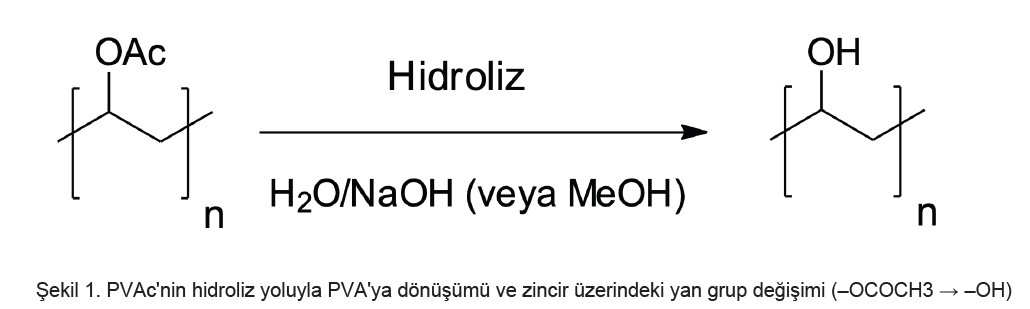
As the degree of hydrolysis increases, the acetate groups present in the polymer chains are converted into hydroxyl groups (Figure 1). As a result, the intermolecular hydrogen bonds formed between chains strengthen, and the crystalline structure of the polymer increases. Due to strong chain interactions, it becomes more difficult for water molecules to penetrate between polymer chains, and the dissolution rate decreases. Conversely, when the degree of hydrolysis decreases, the acetate groups remaining on the chain partially hinder the formation of hydrogen bonds, reduce crystallinity, and allow water to diffuse more easily into the polymer, thereby increasing solubility. [8]
Similarly, as molecular weight increases, the polymer chain length increases and chain entanglement intensifies. For this reason, high-viscosity PVA grades dissolve more slowly than low-viscosity grades. Low molecular weight PVAs, on the other hand, swell and dissolve faster in water due to their shorter chain structures. [5]
This difference is clearly observed commercially in partially hydrolyzed and fully hydrolyzed PVA grades. Partially hydrolyzed PVAs with a degree of hydrolysis of approximately 86–89%, having low crystallinity, can dissolve easily even in cold water, while fully hydrolyzed PVAs with a degree of hydrolysis above 98% exhibit higher crystallinity and generally require temperatures above 60 °C for complete dissolution. [1,2] For this reason, partially hydrolyzed PVAs are preferred in applications requiring rapid dissolution, while fully hydrolyzed PVAs are preferred in applications requiring higher mechanical strength and water resistance.
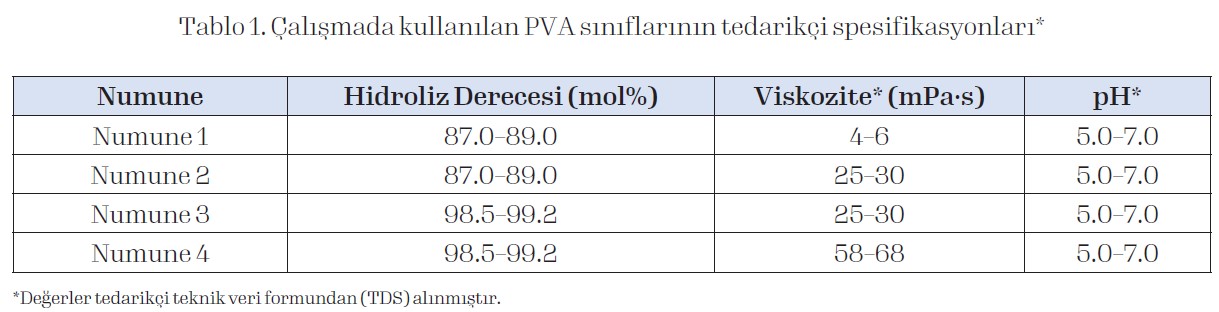
The codes used in naming commercial PVA grades generally provide information about the polymer's viscosity and degree of hydrolysis. [6,7] The Sample 1, Sample 2, Sample 3 and Sample 4 grades used in this study are commercial PVA products with different combinations of degree of hydrolysis and viscosity (Table 1).
Thanks to their adjustable solubility properties, PVA films are used today in many areas such as unit-dose detergent capsules and detergent sheets, water-soluble packaging [1,2], agricultural controlled-release systems, biomedical applications, diagnostic kits [3], and pharmaceutical film technologies [4]. Particularly in the detergent sector, the dissolution performance of PVA films used is one of the critical quality parameters that directly affects the success of the product in use.
Although the effect of degree of hydrolysis and molecular weight on PVA solubility has been examined in detail in the literature, studies directly comparing different commercial PVA grades under the same film production and dissolution conditions are limited. For this reason, in this study, the dissolution times of PVA films prepared from Sample 1, Sample 2, Sample 3 and Sample 4 grades with different degrees of hydrolysis and viscosities were compared; the independent and combined effects of degree of hydrolysis and viscosity on film dissolution behavior were evaluated experimentally.
2. Materials And Methods
2.1. Materials
Four commercial PVA grades (Sample 1, Sample 2, Sample 3 and Sample 4) with different viscosities and degrees of hydrolysis used in the study were procured commercially. Propylene glycol was used as a plasticizer in the film formulations, and pure water was used in solution preparation.
Equipment and materials used in the dissolution tests: thickness gauge (0.001 mm precision), 1000 mL beaker, magnetic stirrer, thermometer, stopwatch (0.01 s precision), sample holder (304 stainless steel frame; outer frame 60×60 mm, inner frame 40×40 mm), plastic holder (clip), and sample cutting apparatus.
2.2. Preparation of PVA Film Solutions
Film solutions were prepared separately for each PVA grade. PVA powder was added to water and first mixed with a magnetic stirrer at 25 °C, then the ambient temperature was raised to 80 °C and mixing continued for varying durations depending on the PVA grade: 30 minutes for Sample 1, 1 hour for Sample 2, 1 hour 25 minutes for Sample 3, and 2 hours for Sample 4, ensuring the complete dissolution of PVA. Propylene glycol was added to the resulting solution, and mixing continued until a homogeneous film solution was obtained.
2.3. Production of PVA Films
The prepared PVA solutions were cast homogeneously at a wet film thickness of 300 µm onto tile surfaces measuring 20×30 cm using an adjustable film applicator (NEURTEK Instruments, Adjustable Film Applicator). The applicator used has a stainless steel precision blade tip and allows film thickness adjustment in the range of 0-8 mm with 10 µm precision using two micrometer heads (micrometer head accuracy ±2 µm), and complies with the ASTM D 823 standard. After the casting process, the films were dried in an oven at 40 °C for 3 hours. The thickness of the films obtained after drying was measured with a caliper and determined to be approximately 75 µm.
2.4. Dissolution Test
Samples were conditioned under (23±2) °C temperature and (50±5)% relative humidity conditions for at least 48 hours, and tested under these conditions.
A piece with a flawless surface was cut from the conditioned PVA film, thickness measurements were taken at multiple points on the film strip with a thickness gauge, and the film with average thickness was carefully cut and placed into a 304 stainless steel sample holder (outer frame 60×60 mm, inner frame 40×40 mm) and firmly fixed with plastic holders (clips).
1000 mL of pure water was added to a 1000 mL beaker, and the water was set to 23 °C temperature with a thermometer. A magnetic stirrer was placed in the beaker, and the stirring speed was adjusted so that the base of the vortex would be close to the 800 mL mark on the beaker, with the vortex depth reaching approximately 200 mL. The sample holder was immersed into the vortex while simultaneously starting the stopwatch. During the test, the disintegration (breaking) time and complete dissolution time of the PVA sample were recorded separately. Measurements were made in duplicate for each PVA grade, and the results were expressed as mean ± standard deviation.
3. Results And Discussion
The measured viscosity values and dissolution test results of the films produced from four PVA grades with different degrees of hydrolysis and viscosities are given in Table 2. The data obtained show significant differences among PVA grades in terms of both disintegration and complete dissolution times. Dissolution time, from shortest to longest, was ranked as Sample 1 (45 s) < Sample 2 (75 s) << Sample 3 (3600 s) < Sample 4 (4500 s);
When the partially hydrolyzed grades (Sample 1 and Sample 2) are compared, although both grades have the same degree of hydrolysis (87–89%), the complete dissolution time of Sample 1 (5.5 cP), which has a lower measured viscosity, was 45 seconds, while the dissolution time of Sample 2 (28 cP), which has approximately 5 times higher viscosity, increased to 75 seconds. This result confirms that even at the same degree of hydrolysis, molecular weight (viscosity) is a determining factor in dissolution rate; low molecular weight chains diffuse into water faster due to less chain entanglement.
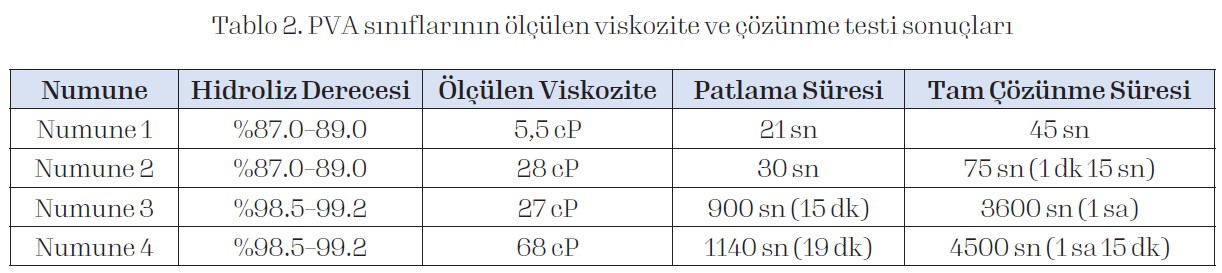
The same trend was observed among fully hydrolyzed grades. When Sample 3 (27 cP) and Sample 4 (68 cP), which have similar degrees of hydrolysis (98.5–99.2%), are compared, both the disintegration time (19 min) and complete dissolution time (75 min) of Sample 4, which has approximately 2.5 times higher measured viscosity, were found to be longer than those of Sample 3 (15 min and 60 min, respectively). This indicates that increased chain entanglement in high molecular weight PVA chains delays the penetration of water molecules into the polymer matrix.
However, the most notable finding of the study is that the effect of the degree of hydrolysis on dissolution time is much more dominant than that of viscosity. When Sample 2 (28 cP, 87–89% hydrolysis) and Sample 3 (27 cP, 98.5–99.2% hydrolysis), which have quite similar viscosity values, are compared, it is seen that despite nearly identical viscosity, the increase in degree of hydrolysis alone extended the dissolution time from 75 seconds to 3600 seconds (approximately 48-fold). This result shows that the intermolecular hydrogen bonding and crystallinity increased by the conversion of acetate groups into hydroxyl groups in fully hydrolyzed PVA chains significantly delays the diffusion of water molecules into the polymer, which is consistent with the literature [8]. In partially hydrolyzed PVAs, the acetate groups remaining on the chain weaken the hydrogen bond network and reduce crystallinity, allowing water to penetrate faster, which explains the dissolution of Sample 1 and Sample 2 within seconds [1,2]
As a result, the data obtained in this study experimentally reveal that PVA film solubility is primarily determined by the degree of hydrolysis, while viscosity has a secondary but measurable effect within the same hydrolysis group. These findings support the preference for low-viscosity, partially hydrolyzed PVA grades (e.g., Sample 1) in applications such as unit-dose detergent systems where rapid dissolution is desired, and for fully hydrolyzed grades (Sample 3, Sample 4) in applications where higher mechanical strength and slower dissolution are required.
REFERENCES
[1] Water-soluble film having improved dissolution and stress properties, and packets made therefrom. US Patent 8,276,756. https://image-ppubs.uspto.gov/dirsearch-public/print/downloadPdf/8276756
[2] Perforated, stable, water soluble film container for detersive compositions. US Patent 5,534,178. https://image-ppubs.uspto.gov/dirsearch-public/print/downloadPdf/5534178
[3] Dissolvable Polyvinyl-Alcohol Film, a Time-Barrier to Modulate Sample Flow in a 3D-Printed Holder for Capillary Flow Paper Diagnostics. Materials 2019, 12(3), 343. https://pmc.ncbi.nlm.nih.gov/articles/PMC6384612/
[4] Use of Polyvinyl Alcohol as a Solubility-Enhancing Polymer for Poorly Water Soluble Drug Delivery (Part 1). PMC. https://pmc.ncbi.nlm.nih.gov/articles/PMC4766132/
[5] PVA dissolution time by molecular weight? ResearchGate, 2024. https://www.researchgate.net/post/PVA_dissolution_time_by_molecular_weight
[6] KURARAY POVAL Standard Grades Characteristics — Technical Data Sheet.
[7] PVA Grades and Specifications, BenTech Chemical. https://www.bentechchemical.com/wp-content/uploads/2021/07/PVA-Grades-and-Specifications_BT.pdf
[8] Polyvinyl Alcohol Water Soluble Polymer: Comprehensive Analysis of Properties, Modifications, and Advanced Applications. https://eureka.patsnap.com/materials/pva-water-soluble-polymer
Gallery
Advertisement
Ad Space728 × 90