TÜRKÇİMENTO: Emissions Trading System Can Accelerate Industry's Green Transformation

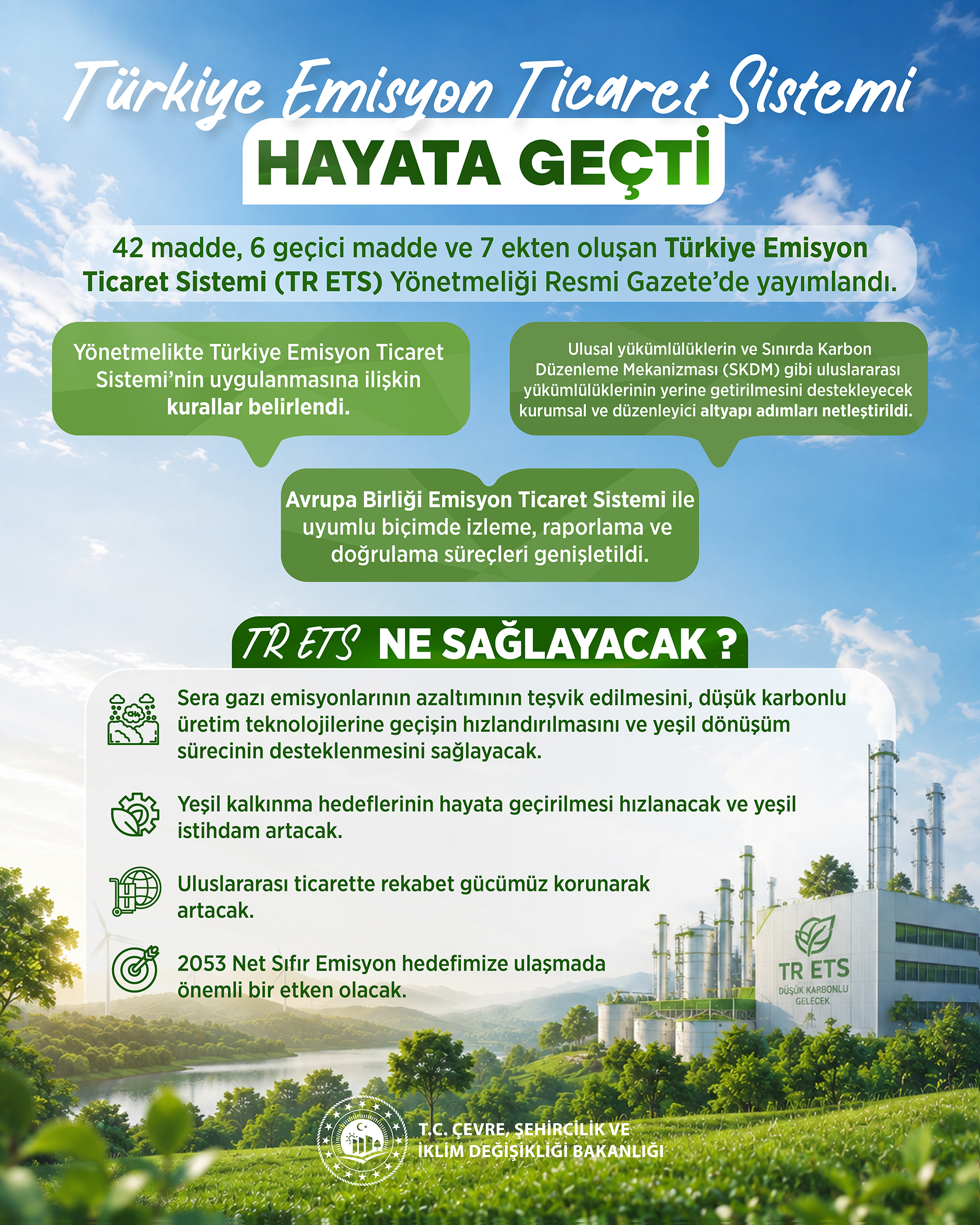
TÜRKÇİMENTO assessed the entry into force of the Emissions Trading System (ETS) Regulation as an important step for Türkiye's 2053 net-zero emissions target and its transition to a low-carbon economy. The cement sector points out that, beyond emissions reduction, ETS needs to be turned into a mechanism that encourages energy efficiency, low-carbon technologies, R&D and green transformation investments.
TÜRKÇİMENTO assessed the entry into force of the Emissions Trading System (ETS) Regulation as an important step for Türkiye's 2053 net-zero emissions target and its transition to a low-carbon economy. The cement sector points out that, beyond emissions reduction, ETS needs to be turned into a mechanism that encourages energy efficiency, low-carbon technologies, R&D and green transformation investments.
TÜRKÇİMENTO, the umbrella organization of the Turkish cement sector, made assessments regarding the entry into force of the Emissions Trading System (ETS), which is considered an important stage in Türkiye's carbon pricing infrastructure.
The organization states that ETS does not merely create a new area of compliance for industry, but that if designed correctly, it can accelerate low-carbon production investments and contribute to preserving the global competitiveness of Turkish industry.
Noting that ETS is an important turning point in Türkiye's transition to a low-carbon economy, TÜRKÇİMENTO CEO Volkan Bozay said, "As the cement sector, we do not see the Emissions Trading System as a compliance burden but as an opportunity to get ahead in global competition. Trade rules and new development models around the world are being reshaped around the axis of low-carbon production. We must not remain outside this transformation, but take a strong place within it. We believe ETS will also be an important tool in preparing Turkish industry for this process."
A predictable ETS design can support investments
Drawing attention to the importance of designing ETS in a way that strengthens industry's transformation capacity, Bozay emphasized that a predictable and balanced transition process is critical for businesses' long-term investment decisions.
Bozay said, "An ETS design that strengthens our industry's transformation capacity will encourage businesses not only to reduce their emissions but also to invest in energy efficiency, innovative production processes and low-carbon technologies. For this reason, in the transition from the pilot period to full implementation, benchmarking criteria that take into account the real conditions of the sectors, a fair transition approach and effective investment support are of great importance."
Carbon cost can provide a source of funding for green transformation investments
TÜRKÇİMENTO states that one of the most important potential contributions of ETS is directing revenues obtained from carbon pricing back into green transformation investments.
Noting that industry's transition to low-carbon production requires long-term and high-value investments, Bozay said it is important for the resources to be obtained from the carbon market to be used in projects related to combating climate change, R&D and green transformation.
Bozay said, "The transformation of industry requires serious and long-term investments. For this reason, it is extremely valuable for revenues obtained from the carbon market to be channeled into investments in combating climate change, R&D and green transformation. In this way, carbon cost can cease to be merely a cost element and instead turn into a sustainable resource that finances the transformation of our industry."
The mechanism for using ETS revenues in climate, R&D and green transformation projects is considered to be one of the elements that could strengthen the system's transformative effect on industry.
The cement sector is focusing on emissions reduction technologies
Thanks to its emissions monitoring and verification work carried out for many years, the Turkish cement sector is among the sectors prepared for ETS's technical and institutional infrastructure.
While facilities producing clinker in rotary kilns with a capacity of 500 tons per day or more are expected to be included in the system both during the pilot period and the main implementation period, several technologies and applications stand out in the sector's decarbonization efforts.
These include:
Use of alternative fuels and alternative raw materials
Increasing energy efficiency
Waste heat recovery
Reducing the clinker/cement ratio
Development of low-carbon production technologies
are included.
In the long term, carbon capture, utilization and storage (CCUS) technologies are expected to play an important role in the cement sector's decarbonization roadmap.
ETS is also important for export competitiveness
Noting that the Emissions Trading System also has strategic importance for Türkiye's foreign trade competitiveness, TÜRKÇİMENTO states that the relationship between the European Union Carbon Border Adjustment Mechanism (CBAM) and ETS in particular is critical for exporting sectors.
With the full implementation of CBAM, the ability to offset carbon fees paid in Türkiye at the EU border is important in terms of the carbon costs that exporting sectors will face.
Bozay said, "The ability to manage Türkiye's carbon cost within its own borders and to direct this resource to green transformation investments will provide a significant advantage for our exporting sectors. Our goal here is not only to comply with new regulations, but to make a strong transition to a low-carbon economy while preserving Türkiye's production power, export capacity and competitiveness."
According to TÜRKÇİMENTO, keeping a portion of the carbon fee that can be offset under CBAM in Türkiye and using it as a resource for green transformation investments could strengthen the long-term effect of ETS on industry.
"We see green transformation as a strategic opportunity"
TÜRKÇİMENTO CEO Volkan Bozay, stating that ETS could be an important transformation tool in line with Türkiye's 2053 net-zero emissions target, completed his remarks as follows:
"As the cement sector, we do not see green transformation as merely an obligation. We regard it as a strategic opportunity for Türkiye to carry its production power into the future and achieve a stronger position in global competition. Our greatest expectation is for ETS to acquire a structure that accelerates this transformation, encourages investments and supports our industry's competitiveness. Through the cooperation of the public sector, private sector, academia and civil society, we can together strengthen Türkiye's low-carbon production capacity. As TÜRKÇİMENTO, we will continue to contribute to the development of policies and mechanisms that will support our sector's transformation."
Gallery