Nobel Chemistry Laureate David MacMillan Visits Koç University
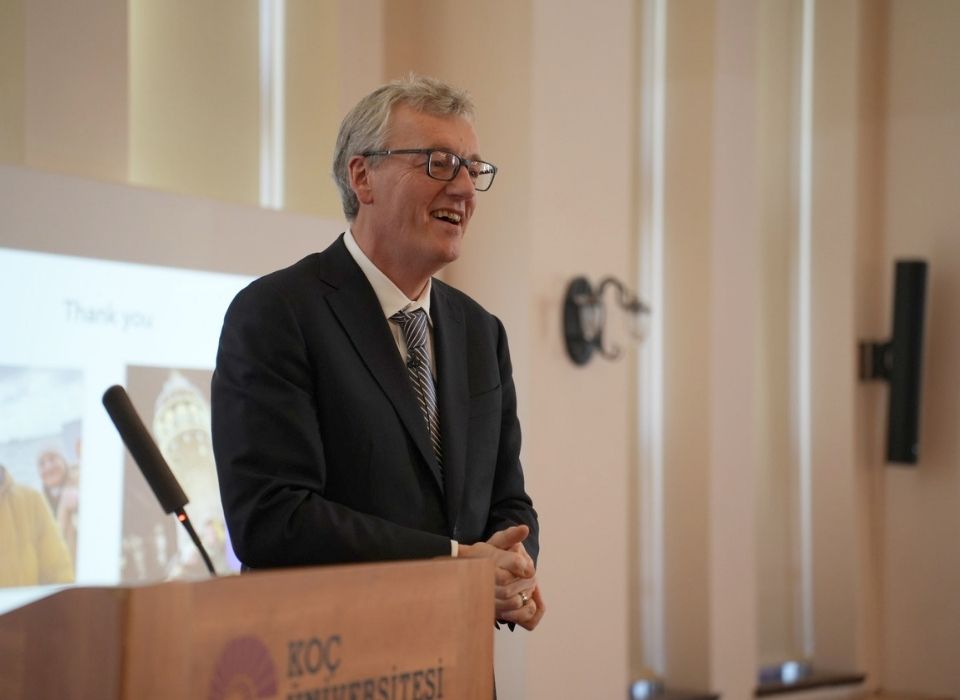
David W. MacMillan, who won the 2021 Nobel Prize in Chemistry, gave a presentation at Koç University on 24 February 2025. Visiting Turkey for the first time at the invitation of Koç University faculty member Prof. Dr. Önder Metin, MacMillan discussed the work that earned him the Nobel Prize and his experiences following the award in an enjoyable presentation frequently punctuated by laughter.
David W. MacMillan, winner of the 2021 Nobel Prize in Chemistry, delivered a presentation at Koç University on 24 February 2025. Visiting Turkey for the first time at the invitation of Koç University Faculty Member Prof. Dr. Önder Metin, MacMillan shared the work that won him the Nobel Prize and his experiences after receiving it in an engaging presentation frequently punctuated by laughter.
The 2021 Nobel Prize in Chemistry was awarded to Benjamin List (Max Planck Institute for Coal Research, Germany) and David W.C. MacMillan (Princeton University, USA) for developing the "asymmetric organocatalysis" process. But what is this asymmetric organocatalysis?
All matter in the universe consists of molecules made up of various atoms bonded together in various forms. Everything from the plastic on the computer keyboard on which this text is being written to the internal organs in our bodies. However, the processes that bring these atoms together are generally slow and require an accelerator. These accelerators are catalysts.
Catalysts are substances that speed up chemical reactions but are not present in the new product that emerges from the reaction. For example, enzymes in our bodies regulate biochemical processes that produce the molecules needed for us to survive, or catalysts such as copper and platinum play a role in processes that cause the oxidation of hydrocarbons in automobile exhaust gases. Beyond these, many industrial material production processes with which we are familiar in daily life are only possible with catalysts.
Until the asymmetric organocatalysis method developed independently by Benjamin List and David W.C. MacMillan in 2000, scientists believed there were only two types of catalysts: enzymes and metals. This new method is not only fast, but also efficient and environmentally friendly. According to Nobel Chemistry Committee Chair Johan Aqvist, "This new catalysis concept is as brilliant as it is simple. The fact that many of us did not think of it earlier has occurred to many of us."
List's work began by focusing on removing metals used during catalysis, questioning whether only amino acids could be used to accelerate a chemical reaction. He tried this with an amino acid called proline and succeeded: proline performed an aldol reaction that brought together two carbon atoms from different molecules.
MacMillan succeeded in the asymmetric catalysis dimension of the process. When molecules form, sometimes two different molecules emerge that are mirror images of each other, like the reflection we see in a mirror. They are actually the same molecules, but can be thought of as inverted, and therefore have different functions. Our bodies can recognize them, but researchers producing chemical products, especially in the pharmaceutical industry, need only one of them. MacMillan aimed to develop organic molecules that could replace metals providing electrons in the synthesis of desired mirror-image molecules and achieved 90 percent success with the method he used. When publishing his results, he also introduced the term asymmetric organocatalysis.
Thanks to organic catalysts used by scientists since 2000, more efficient results have been obtained in many areas from pharmaceutical production to solar panels. Additionally, since common elements such as oxygen, nitrogen, sulfur and phosphorus are used in the processes, they are inexpensive and not harmful to the environment.
Gallery