Fundamental Quantum Model Achieved with Nanographenes

"Breakthrough in Quantum Technologies: Theoretical Model Made Reality with Nanographenes"
Quantum technologies leverage the unusual properties of matter's most fundamental building blocks to open doors to groundbreaking advances in communications, computing, sensors and many other fields. However, quantum states are highly sensitive and difficult to understand, making it challenging to apply these technologies in real-world applications. Empa researchers and their partners achieved a success in this area: using a method that could be called "quantum Lego," they converted a known quantum physics model into reality in a synthetic material.
Computers use bits as the smallest unit of information, holding values of 1 or 0. Quantum computers operate on the same principle but use a more advanced unit called a "qubit." Qubits can also have two fundamental states, but thanks to the quantum effect, these states can simultaneously take on both values. This uncertainty can grant quantum computers superhuman capabilities; in theory, quantum computers can perform in seconds operations that today's most powerful computers struggle to solve.
To obtain 1 and 0 values in qubits, the "spin" property of electrons is utilized. Spin describes a type of rotational motion of electrons and can be oriented upward (1) or downward (0). Through quantum mechanics, when a spin's orientation changes, the state of other spins connected to it is also affected. However, although this interaction can be defined mathematically, applying the theory in practice is quite complex.
Model Becomes Reality
Researchers in the nanotech@surfaces laboratory at Empa developed a method that makes it possible to enable controlled interaction of spins and to "listen" to these interactions. Through this, they succeeded in creating an ideal chain composed of electron spins and measuring its properties in detail. Their work was published in the journal Nature Nanotechnology.
The theoretical foundation of this chain is a model familiar to students beginning physics: a chain of spins connected with different strengths to each other. This "one-dimensional commutative Heisenberg model" was first described approximately 100 years ago by Werner Heisenberg, one of the founders of quantum mechanics.
Carbon Goblet
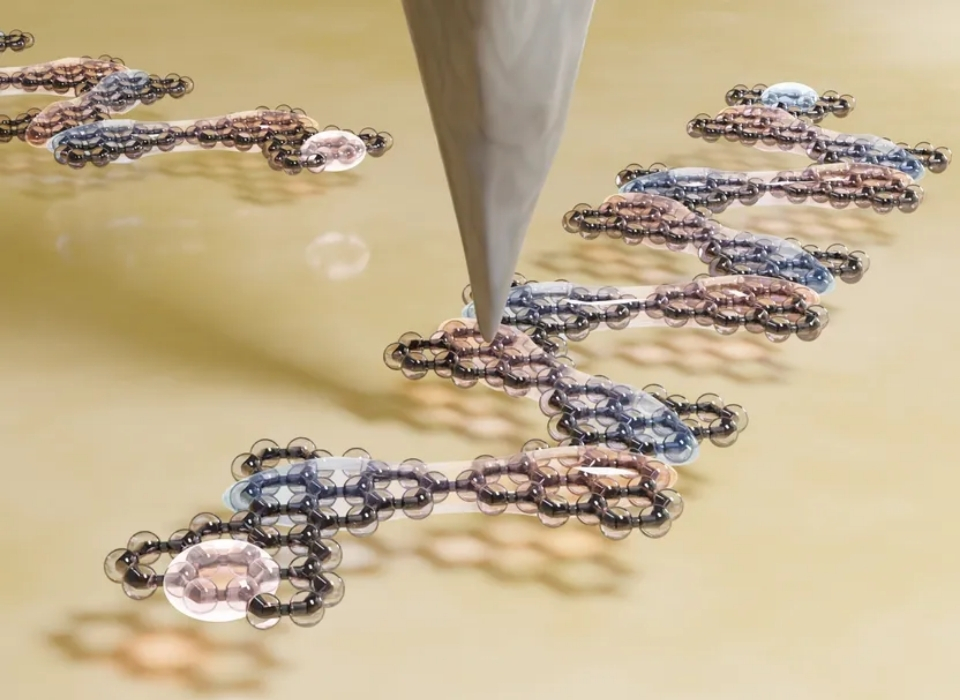
To create this artificial quantum material, Empa researchers used small fragments of graphene, a two-dimensional carbon material. The shape of these "nanographene" molecules determines their physical properties and therefore their spin structures. To construct the Heisenberg model, the researchers chose the "Clar goblet" molecule. This special nanographene molecule consists of eleven carbon rings arranged in the shape of a watch glass with unpaired electrons at its ends, each carrying a spin.
The researchers bonded these goblets to each other on a gold surface to create chains. The two spins within a molecule were weakly bonded, while spins between molecules were strongly bonded; thus, they achieved a perfect realization of the Heisenberg chain. Scientists who could precisely adjust the length of the chains were able to examine the complex physics of this new quantum material in detail by turning individual spins on and off.
From Theory to Practice
Roman Fasel states that thanks to Clar goblet synthesis, the ability to produce Heisenberg chains, like this study, will open new doors in quantum research. "We have shown that we can experimentally test quantum physics theories using nanographenes," he says. "With nanographenes having different spin structures, other types of chains or more complex systems can also be created."
To be a pioneer in applied quantum physics, theoretical and experimental scientists must collaborate. Chemists at Dresden University of Technology provided Empa researchers with starting molecules for Clar goblet synthesis, while scientists from the International Iberian Nanotechnology Laboratory in Portugal contributed theoretical knowledge to the project. Fasel emphasizes that such breakthroughs are possible not only with theoretical knowledge from physics textbooks, but through sophisticated theory-experiment collaboration.
Source: https://www.chemeurope.com/en/news/1184798/fundamental-quantum-model-recreated-from-nanographenes.html
Gallery