Key Statements from the 2nd Türeb Financial Institution Stakeholders Meeting
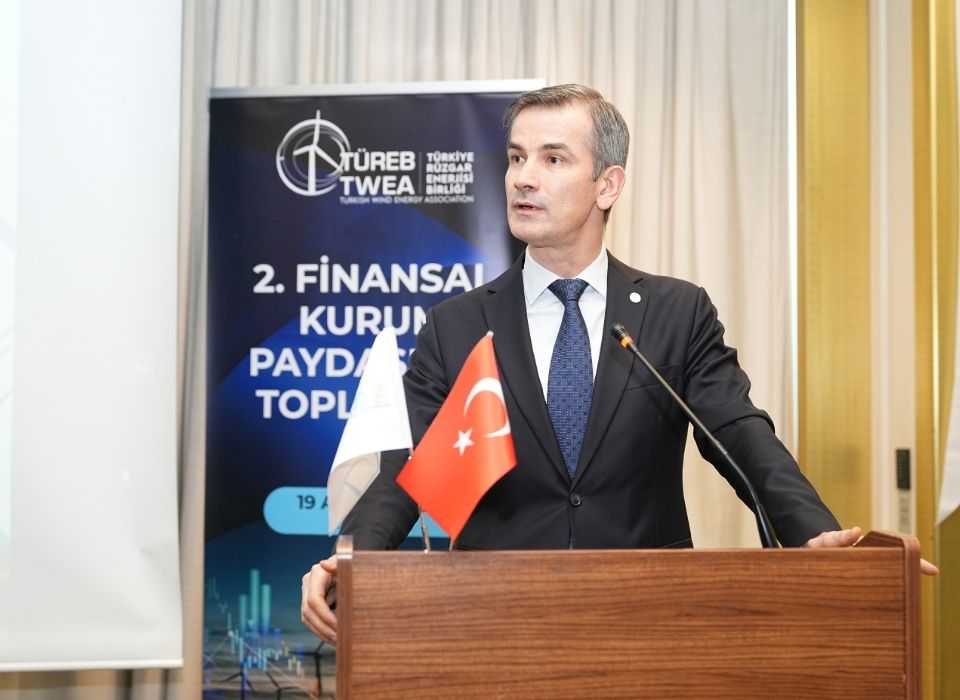
The “2nd TÜREB Financial Institution Stakeholders Meeting” was organized by TÜREB at the dawn of this new period, aiming to strengthen communication and exchange ideas between its investor and main industry members and its corporate members and stakeholders operating in the financial sector…
TUREB organized the "2nd TUREB Financial Institution Stakeholders Meeting" at the dawn of this new era to strengthen communication and exchange ideas between investor and primary industry members and corporate members and stakeholders operating in the financial sector...
The wind energy sector, an important part of Turkey's renewable energy transition, witnessed the lowest annual installation in the last 13 years in 2023, with new installed capacity additions barely exceeding 500 MW. TUREB Chairman İbrahim Erden stated in his remarks that annual wind energy installations could reach approximately 750 MW by year-end 2024.
The TUREB Financial Institution Stakeholders meeting was attended by nearly 150 sector professionals including representatives from public institutions, turbine manufacturers, blade manufacturers, tower manufacturers, engineering firms, banks, consulting companies, logistics companies, civil society organizations, investors and industrialists.
EUR 15 billion investment
TUREB Chairman İbrahim Erden noted that Turkey has invested approximately EUR 15 billion in wind energy installed capacity: "Ten years ago, 55 percent of the global wind energy market was dominated by Western turbine suppliers, whereas today Western turbine manufacturers control only 36 percent of the turbine market. Expansionary fiscal policies applied during the COVID-19 pandemic, supply chain problems, rising energy prices and Russia's invasion of Ukraine increased global inflation rates, prompting many central banks to raise interest rates to ensure price stability. In Turkey, the additional increase in borrowing costs coupled with rising country risk premiums, combined with the end of the YEKDEM-1 period as of 2021, caused a significant contraction in investment volumes. On the other hand, despite changing financial conditions, our currently operational wind energy installed capacity of approximately 12,900 MW with EUR 15 billion in investment, and our total project portfolio exceeding 24,000 MW including licensed storage facilities and other projects. Furthermore, with the 2035 Renewable Energy Vision announced by our Ministry of Energy and Natural Resources and new targets, wind energy installed capacity is projected to reach 50,000 MW by 2035. At a time when Turkey's CDS values have returned to relatively normal levels and the FED and ECB have begun cutting rates, it is an inevitable reality that the implementation of 24 GW of pre-licensed/licensed investments in the coming years will require twice the financing sources provided to date," he said.
Stating that the purpose of organizing the 2nd TUREB Financial Institution Stakeholders Meeting is to better understand financing needs for renewable energy projects and create a strong dialogue platform between financial institutions and our sector, Erden noted: "Among us are 32 valued bankers representing 26 different banks, 12 representatives of different financial institutions and approximately 30 TUREB management and supervisory board members. Additionally, representatives of our member public institutions and senior executives, finance managers and other representatives of our sector form a strong participant group of nearly 150 in total. Recently, important regulatory amendments have been implemented concerning renewable energy development. These amendments are being carried out to strengthen the sector and further integrate renewable energy into the grid and market system. To briefly mention:
• Through the Aggregator Activities Regulation, demand-side participation has been encouraged, increasing market flexibility.
• Through Storage Activities Regulation Amendments, integration of storage-equipped production facilities has been achieved.
• Through Grid and Ancillary Services Regulation Amendments, innovations such as frequency sensitivity modes and reactive power support services have been introduced.
These amendments aim to make the sector more competitive while accelerating system integration of renewable energy," he stated.
Gallery
Advertisement
Ad Space728 × 90