A Dual Cross-Linking Strategy: Enhancing the Mechanical Performance of Elastomeric Polymer Networks with Benzophenone Derivatives and Calcium Carboxylate Ions

Abstract
The trade-off between flexibility and mechanical and light durability is a fundamental problem in the design of elastomeric networks for outdoor use. In systems containing a single type of cross-link, increasing cross-link density raises hardness but reduces chain mobility and energy-dissipation capacity. This article discusses the chemical basis of a dual cross-linking strategy in which the UV-triggered photo-covalent cross-linking of benzophenone derivatives is combined with reversible ionic bridges formed by calcium carboxylate ions in a single elastomeric network. The covalent network provides structural integrity and permanence that grows over time, while the ionic bridges act as sacrificial bonds that break and re-form, dissipating energy. The reaction pathways, the role of each mechanism in the network architecture, the design parameters and the characterisation approaches are discussed systematically.
Keywords: benzophenone, photo-cross-linking, calcium carboxylate, ionic bridge, elastomer, dual network
1. Introduction
Polymeric materials used outdoors are exposed simultaneously to the UV component of sunlight, large temperature swings, humidity, rain and wind. UV photons can generate radicals and cause chain scission in polymer chains. Temperature changes make the material expand and contract repeatedly, building up mechanical stress in the structure. Together, these effects require the chemical design of a long-lived elastomeric material to be deliberate.
Conventional approaches often involve a trade-off between flexibility and durability. Highly flexible systems may lack UV resistance and mechanical strength. When cross-link density is raised to increase hardness and strength, the mobility of chain segments is restricted, elasticity falls and the network becomes brittle [1]. In a brittle network, micro-cracks form and propagate more easily.
This work considers the combination of two cross-linking mechanisms of different nature in a single elastomeric binder to overcome this trade-off. The first is permanent covalent bonding based on the UV-triggered hydrogen abstraction of benzophenone derivatives. The second is reversible ionic bridging between carboxylate groups on the chain and calcium ions (Ca²⁺). A similar covalent–ionic hybrid principle has been reported to give exceptional toughness in aqueous gel systems [2, 3]. Here the same principle is adapted to elastomeric polymer networks with a light-triggered covalent component.
2. The Role of Cross-Linking in Polymer Networks
Cross-linking creates chemical or physical connections that turn individual polymer chains into a three-dimensional network. Cross-links prevent chains from sliding permanently past one another, so the material does not flow under load and returns to its original shape when the load is removed. The characteristic behaviour of elastomers arises from this network structure. According to rubber elasticity theory, the elastic modulus of the network is proportional to the number of effective network strands per unit volume [1].
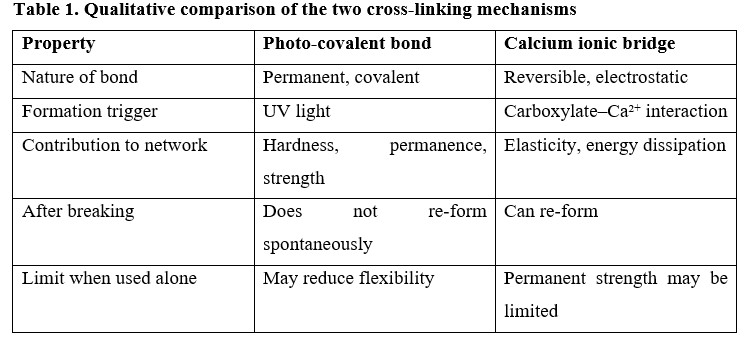
The type of cross-link determines network behaviour. Covalent bonds are strong and permanent, but they do not re-form spontaneously once broken. Ionic and other physical interactions are weaker, but they can re-form after breaking. This difference is the main rationale for the dual-network design. Table 1 gives a qualitative comparison of the two mechanisms.
3. First Mechanism: Photo-Covalent Cross-Linking with Benzophenone Derivatives
Benzophenone and its derivatives are widely used in photochemistry [4, 5]. The carbonyl group (C=O) in their structure absorbs UV light and is converted into a reactive species able to form permanent bonds with polymer chains. The mechanism can be summarised in three consecutive steps:
1. Excitation: The carbonyl group of benzophenone absorbs UV energy, reaching the singlet excited state and then, by intersystem crossing, the reactive triplet state. The efficiency of this crossing is high in benzophenone.
2. Hydrogen abstraction: The carbonyl oxygen of the triplet state abstracts a hydrogen atom from hydrogen-bearing sites on the polymer chain (for example allylic or tertiary C–H), producing a ketyl radical and a polymer radical.
3. Bond formation: Radicals formed on two chains combine to create a C–C bond between the chains, producing a permanent covalent network.
In this mechanism, benzophenone behaves as a light-activated cross-linker. Triggering the reaction with light makes cross-linking controllable in time and space. In addition, when benzophenone is covalently attached to the polymer chain, loss by migration and volatilisation is reduced, which helps keep the photoactive group permanently within the network.
The process increases surface hardness and strength. It allows additional bonds to form as UV exposure continues, so the strength of the material increases over time while colour stability is maintained. In this design UV changes from a cause of degradation into a trigger that strengthens the network. However, photo-cross-linking alone does not always guarantee sufficient flexibility. As covalent bond density increases, the network stiffens and the risk of brittleness under stress arises. This limitation forms the rationale for the second mechanism. The process is illustrated schematically in Figure 1.
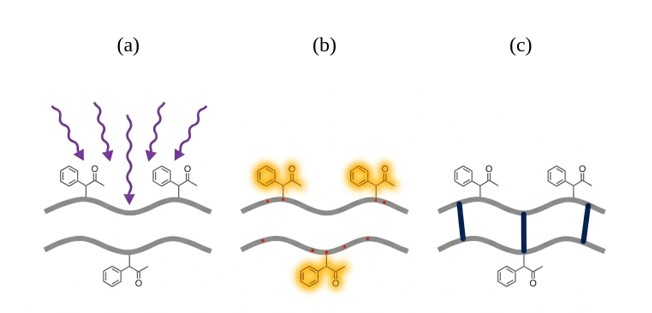
Figure 1. Schematic of UV-triggered photo-covalent cross-linking with benzophenone derivatives. Left to right: (a) UV light reaching the benzophenone group, (b) radicals formed when the excited (triplet) carbonyl abstracts hydrogen from the polymer chain, (c) permanent covalent C–C bond formed between two chains by radical coupling. Grey lines represent polymer chains and the dark blue bar a covalent cross-link.
4. Second Mechanism: Ionic Bridges via Calcium Carboxylate
Carboxylic (–COOH) or carboxylate (–COO⁻) groups on the polymer chain associate with calcium ions (Ca²⁺) in the formulation to form ionic bridges. Because calcium is a divalent ion, it can interact with two carboxylate groups simultaneously and therefore link different chains. In the ionomer literature, such ionic groups form multiplets and clusters within a low-polarity polymer matrix, which become physical junctions of the network [6].
This interaction is more flexible than a covalent bond, yet still provides high strength. The ionic bridges create stretchable links within the network. Under mechanical stress these bonds break and dissipate energy, and when the stress is removed they can re-form. This reversible behaviour helps the material accommodate impact, vibration and thermal variation, and helps bridge surface micro-cracks.
The behaviour of ionic bonds is sensitive to humidity, temperature and ion concentration. Balancing the amount of calcium against the carboxylate content is therefore one of the key design parameters. Too little calcium relative to carboxylate groups limits bridge density, while too much can cause stiffening and phase separation in the network. This interaction is shown schematically in Figure 2.
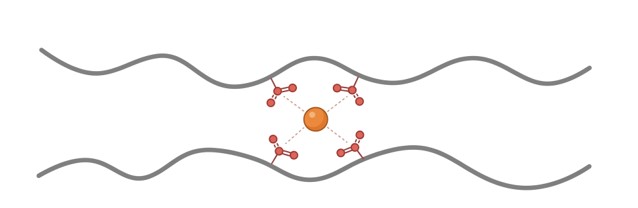 ,
Figure 2. Schematic of the ionic bridge formed by a calcium ion between two carboxylate groups. Grey lines represent two parallel polymer chains, carboxylate (–COO⁻) groups on the chains are the negatively charged sites, the orange sphere is the calcium ion (Ca²⁺), and dashed lines are the reversible ionic interactions.
5. Dual-Network Architecture and Synergy
Covalent bonds provide permanence, hardness and strength that grows under UV. Ionic bridges provide energy dissipation and elasticity. The dual-network structure aims to combine flexibility and mechanical resistance, which stand in opposition in single-mechanism systems, within one material.
The principal source of toughness in dual-network systems is the sacrificial-bond principle [2, 7]. When load is applied, the weaker ionic bridges break first and consume energy. Meanwhile the permanent covalent network preserves the integrity of the material and allows the shape to be recovered once the load is removed. Because ionic bridges can re-form, this protection is not single-use. It is also thought that broken ionic bonds release previously unstretched chain segments, allowing the network to extend further [7].
The complementarity of the mechanisms operates on two levels. The first is mechanical: the covalent network carries load and the ionic network dissipates energy. The second is temporal: UV exposure strengthens the covalent network over time, while the re-formability of the ionic network limits the accumulation of micro-damage. This division of labour is the main advantage of the dual-network approach over single-mechanism systems. The dual-network architecture is shown in Figure 3, and its behaviour under load in Figure 4.
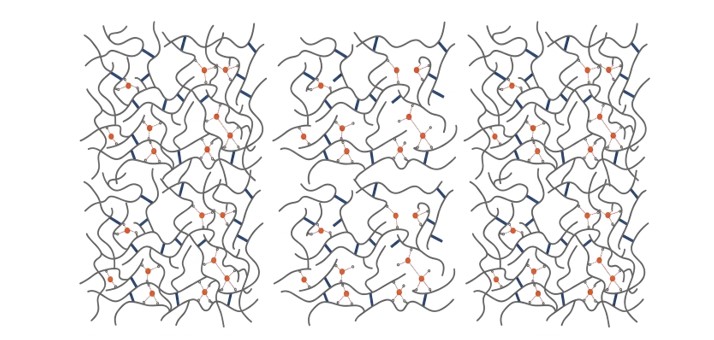
Figure 3. Schematic of the dual cross-linked elastomeric network containing covalent and ionic cross-links. Grey lines represent polymer chains, dark blue bars permanent covalent cross-links, orange spheres calcium ions (Ca²⁺), and dashed lines the reversible ionic bridges between calcium ions and carboxylate groups on neighbouring chains.
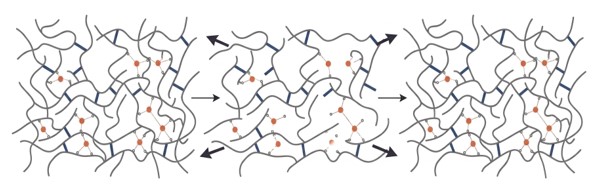
Figure 4. Energy dissipation under load: ionic bridges break during stretching and re-form after unloading. Left to right: (a) unstretched network, (b) stretched network; ionic bridges break and dissipate energy while covalent bonds remain intact, (c) network after unloading, with ionic bridges re-formed. The colour code is the same as in Figure 3.
6. Design Parameters Governing Network Structure
Dual-network performance depends on several interacting parameters. Evaluating them individually and together makes it possible to tune the network architecture to the targeted behaviour:
1. Benzophenone-derivative concentration and UV dose: These determine covalent cross-link density. A high dose increases hardness and may reduce flexibility.
2. Carboxylate group content: This sets the number of ionic binding sites on the chain and defines the upper limit of the ionic network.
3. Calcium concentration: This affects bridge density and the size of ionic clusters. Its ratio to carboxylate groups is critical.
4. Polymer backbone: Glass-transition temperature and chain mobility influence the rate at which ionic bridges re-form.
5. Environmental conditions: Humidity and temperature change the strength and re-association kinetics of ionic interactions.
7. Characterisation Approaches
Evaluating the two networks together requires complementary methods sensitive to each mechanism. At the chemical level, FTIR spectroscopy allows the decrease of the benzophenone carbonyl band and the shifts of the carboxylate bands to be followed. Network structure is assessed through cross-link density using swelling and gel-fraction measurements. Tensile and stress-relaxation experiments make it possible to distinguish the energy-dissipation contribution of the ionic bridges from the recovery behaviour of the covalent network. Dynamic mechanical analysis reveals glass-transition behaviour and secondary transitions associated with ionic clusters. Durability is evaluated by comparing properties after accelerated UV exposure and temperature cycling.
8. Discussion and Evaluation
The combined use of photo-covalent and ionic cross-linking offers a strong design strategy for elastomeric polymer networks. The appeal of the approach lies in combining, in one chemical system, a light-programmable permanent network with a self-recovering energy-dissipating network. However, its success depends on the two networks not hindering each other's formation. The effect of ionic clusters on light transmission and chain mobility may influence the hydrogen-abstraction efficiency of benzophenone. The order and ratio of the components must therefore be optimised carefully.
In future, comparing different divalent ions, different benzophenone derivatives and backbones with different carboxylate contents will allow structure–property relationships to be established in more detail. Such systematic studies can guide the rational chemical design of elastomeric materials that withstand outdoor conditions.
9. Conclusion
Combining photo-covalent cross-linking with benzophenone derivatives and ionic cross-linking with calcium carboxylate in a single elastomeric network is a chemically well-founded route to overcoming the conventional trade-off between flexibility and mechanical strength. The covalent network provides permanence, hardness and strength that increases under UV, while the ionic bridges provide elasticity and energy dissipation. The dual-network architecture aims to deliver the two properties in a complementary rather than competing manner.
References
[1] Rubinstein M., Colby R. H. Polymer Physics. Oxford University Press, 2003.
[2] Gong J. P. Why are double network hydrogels so tough? Soft Matter, 2010, 6(12), 2583–2590.
[3] Sun J.-Y., Zhao X., Illeperuma W. R. K., Chaudhuri O., Oh K. H., Mooney D. J., Vlassak J. J., Suo Z. Highly stretchable and tough hydrogels. Nature, 2012, 489, 133–136.
[4] Dorman G., Prestwich G. D. Benzophenone photophores in biochemistry. Biochemistry, 1994, 33(19), 5661–5673.
[5] Turro N. J., Ramamurthy V., Scaiano J. C. Modern Molecular Photochemistry of Organic Molecules. University Science Books, 2010.
[6] Eisenberg A., Hird B., Moore R. B. A new multiplet-cluster model for the morphology of random ionomers. Macromolecules, 1990, 23(18), 4098–4107.
[7] Ducrot E., Chen Y., Bulters M., Sijbesma R. P., Creton C. Toughening elastomers with sacrificial bonds and watching them break. Science, 2014, 344(6180), 186–189.
Gallery
Advertisement
Ad Space728 × 90