Two-Faced Nanoparticles Could Give Antibiotics New Life

For decades, many disease-causing bacterial species have developed defenses even against the most powerful antibiotics, triggering a growing health crisis. The rise of antibiotic-resistant "superbugs" has also set off an arms race. As microbes find new ways to withstand drugs, researchers are seeking new methods to break down their defenses.
For decades, multiple disease-causing bacterial species have developed defenses against even the most powerful antibiotics, triggering a growing health crisis. The rise of antibiotic-resistant "superbugs" has also sparked an arms race. As microbes find new ways to resist drugs, researchers are seeking new methods to break through their defenses.
As a significant step forward, a research team led by Yan Yu, Art Krieg Professor in the Chemistry Department of the College of Arts and Sciences and the Department of Biomedical Engineering of the McKelvey School of Engineering, has restored the potency of failing antibiotics by combining them with "two-faced" nanoparticles—ultra-small material building blocks smaller than 100 nanometers. The nanoparticles showed remarkable ability to disrupt bacterial cell walls, leaving microbes vulnerable to attack.
Yu said, "The nanoparticles super-charged the antibiotics. This research may point to a new path for breathing new life into old antibacterial drugs."
The study was published in Nano Letters. Co-authors of the article include Yu's colleagues at Indiana University and Osaka University in Japan.
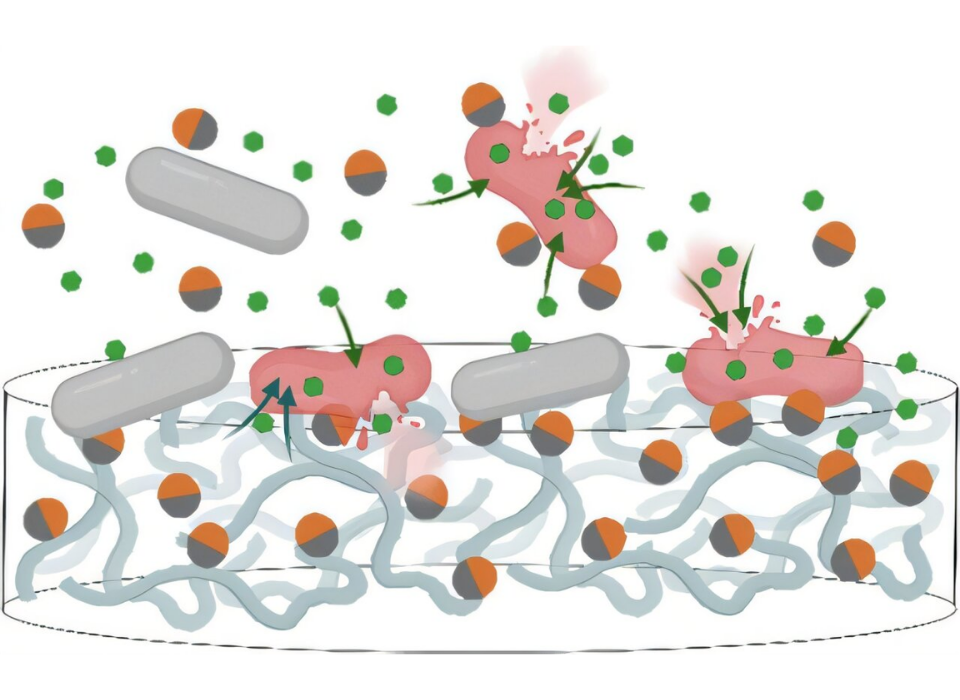
Yu and his team created nanoparticles with two different faces. Named after Janus, the two-faced Roman god representing the beginnings and endings of things, these particles double the possibilities for chemists. One face was coated with positively charged molecules that help the nanoparticles adhere to bacterial cell walls. The other face was coated with hydrophobic (water-repelling) molecules that cause the cell wall to rupture. Yu said, "A single Janus nanoparticle strikes two blows in one shot."
Yu explained that once the cell wall is disrupted, antibiotics seep in more easily and ultimately kill the microbes. The team found that the combination of Janus nanoparticles and antibiotics killed drug-resistant strains of E. coli and A. baumannii—two bacterial species that pose significant risk to human health—much more efficiently than antibiotics alone. One of the A. baumannii strains was an antibiotic-resistant variant collected from a hospital.
Yu noted that other types of nanoparticles have been used to fight bacteria, and in some cases microbes have shown the ability to develop defenses against these small-scale threats. However, because Janus nanoparticles attack the cell wall directly from two sides, developing any resistance would likely be a slow and complicated process: "Even if bacteria develop some form of resistance, it would probably occur over a long time period."
Should bacteria develop defenses against a particular type of two-faced nanoparticle, researchers can always fine-tune and change the molecules attached to both sides. Yu said, "Janus nanoparticles are tunable and customizable, which is a major advantage."
In the future, Yu hopes to launch new collaborations with researchers across WashU, including the McKelvey School of Engineering and WashU School of Medicine. He wants to work with clinicians to test Janus nanoparticles in hospital settings, perhaps in patients' wound healing processes. He also aims to collaborate with researchers in chemistry and engineering to customize nanoparticles and explore new options for producing them in large quantities for clinical applications.
Despite having been at WashU for only a few months (started in July), Yu is already excited about the possibilities of new connections. "WashU has many talented researchers to work with and learn from," he said. "This is an ideal place to advance my group's research."
Source Martijn Zwama et al, Amphiphilic Janus Nanoparticles Synergize with Antibiotics to Restore Susceptibility in Drug-Resistant Gram-Negative Bacteria, Nano Letters (2025). DOI: 10.1021/acs.nanolett.5c05337 / Journal information: Nano Letters / Provided by Washington University in St. Louis / https://phys.org/news/2026-01-reviving-antibiotics-nanoparticles.html
Gallery